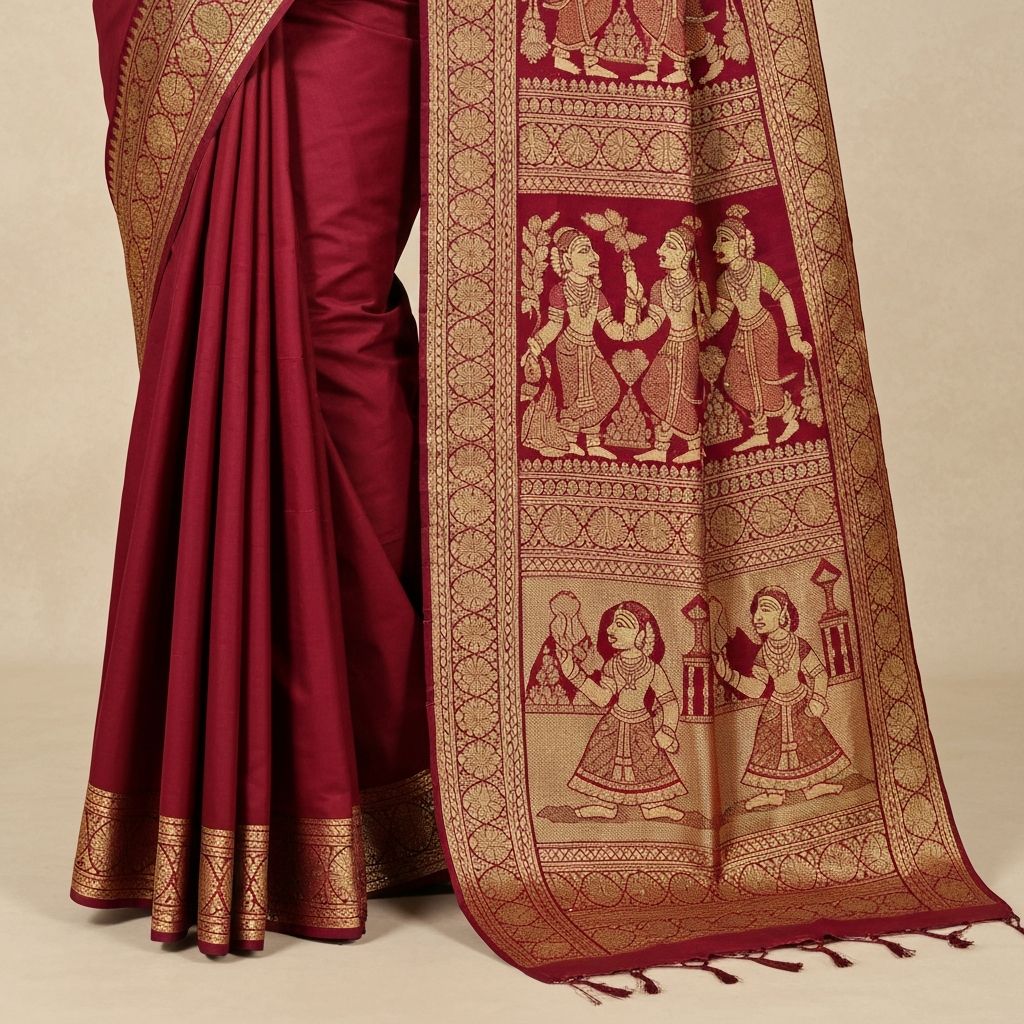
Baluchari Saree
Epics woven in silk - Bengal's storytelling sarees.
Origin
Baluchar, West Bengal
History
18th Century (Nawab Era)
Technique
Jacquard Loom
Recognition
GI Tagged
Baluchari sarees originated in the village of Baluchar in Murshidabad district during the Nawab period of Bengal. What makes these sarees extraordinary is their elaborate pallu featuring woven scenes from Hindu epics like Ramayana and Mahabharata.
The art nearly died out when the village was flooded by the Bhagirathi River in the early 20th century. It was revived in the 1950s in Bishnupur, Bankura district, where it continues to flourish today. The weavers of Bishnupur have added their own innovations while preserving the traditional narrative style.
Each Baluchari pallu tells a complete story - chariots racing, kings in court, deities in blessing posture - all achieved through the intricate manipulation of warp and weft threads on the loom.
Distinctive Features
Narrative Pallu
Elaborate scenes from epics woven in the pallu
Pure Silk
High-quality mulberry silk with natural sheen
Supplementary Weft
Figures created using extra weft technique
Rich Colors
Deep maroons, purples, and blues with gold
Intricate Borders
Complementary designs along the length
Time Intensive
Single saree takes weeks to complete
Popular Narratives
- Scenes from the Ramayana - Rama's coronation, Sita's swayamvar
- Mahabharata episodes - Krishna with Arjuna, dice game
- Raghuvansh - Royal lineage tales
- Nawabi motifs - Hookahs, European figures (later additions)