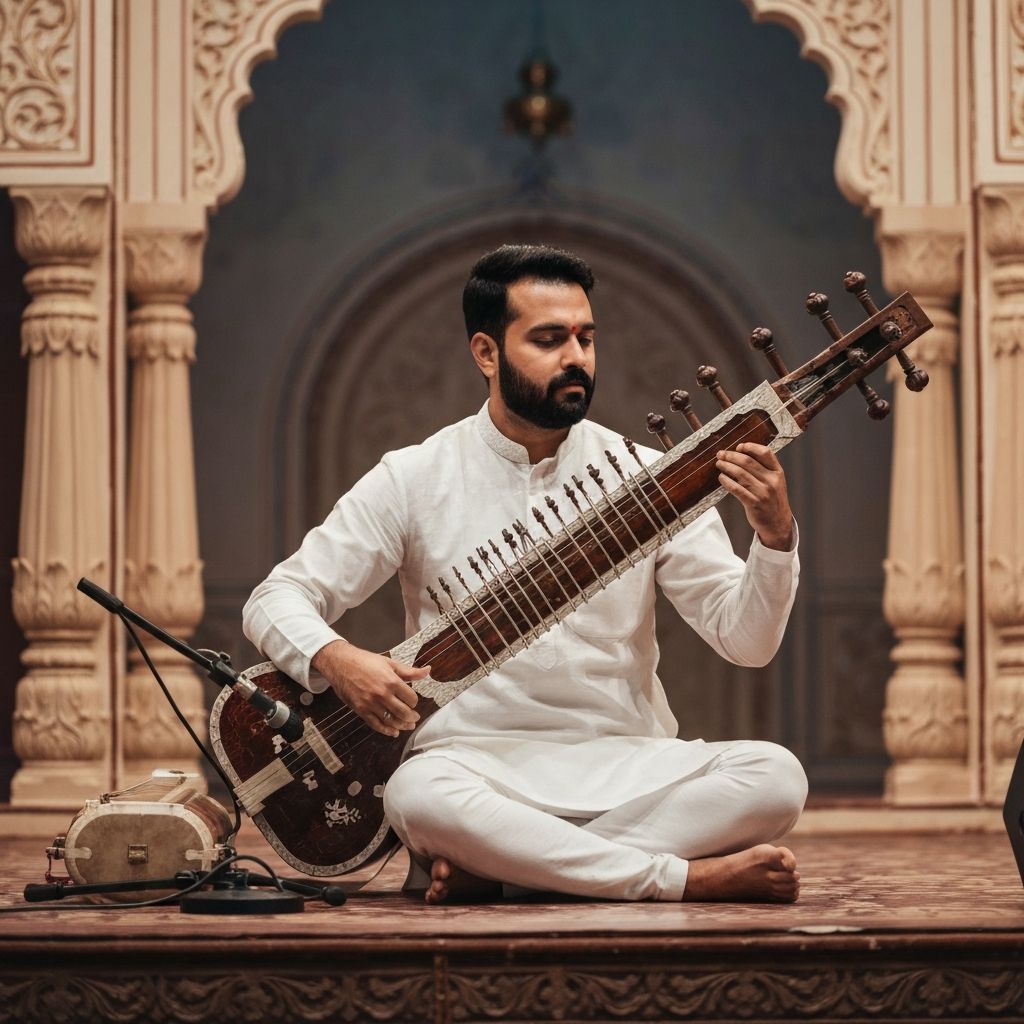
Hindustani Classical Music
The soul-stirring melodic tradition of North India, where ragas paint emotions through sound.
Region
North India
Origin
Vedic Period (1500 BCE)
Ragas
300+ Traditional Ragas
Gharanas
6+ Major Schools
Hindustani Classical Music is one of the two main traditions of Indian classical music, the other being Carnatic music of South India. It evolved from ancient Vedic traditions and was significantly influenced by Persian and Central Asian music during the medieval period.
The foundation of Hindustani music lies in the concept of Raga - a melodic framework for improvisation - and Tala - the rhythmic cycle. Each raga is associated with specific times of day, seasons, and emotions, creating a profound connection between music, nature, and human consciousness.
The tradition is preserved and transmitted through the guru-shishya parampara(teacher-student tradition) and organized into gharanas, each with its distinct style and approach to performance.
The Gharana Tradition
Gwalior Gharana
The oldest and most influential, known for its balanced approach to khayal singing with equal emphasis on melody and rhythm.
Agra Gharana
Known for its powerful voice production and emphasis on rhythm. Famous for nom-tom alap.
Kirana Gharana
Emphasizes slow, meditative alap and meend (glides). Known for its soulful and devotional quality.
Jaipur-Atrauli Gharana
Known for complex ragas and intricate taans. Emphasizes rare and difficult ragas.
Patiala Gharana
Famous for its romantic gayaki with elaborate taans and colorful ornamentations.
Rampur-Sahaswan Gharana
Known for its balanced approach combining elements from multiple traditions.
Traditional Instruments
Sitar
Stringed instrument with sympathetic strings
Sarod
Fretless string instrument with metal fingerboard
Tabla
Pair of drums for rhythmic accompaniment
Tanpura
Drone instrument providing harmonic base
Sarangi
Bowed string instrument for vocal accompaniment
Bansuri
Bamboo flute with meditative quality
The Science of Raga
Each raga is a complex melodic entity with specific ascending and descending patterns, characteristic phrases, and mood associations. The time theory (samay siddhanta) assigns ragas to specific times for optimal emotional impact.
- Morning Ragas: Bhairav, Todi, Ahir Bhairav
- Evening Ragas: Yaman, Puriya, Marwa
- Night Ragas: Darbari, Malkauns, Bageshri