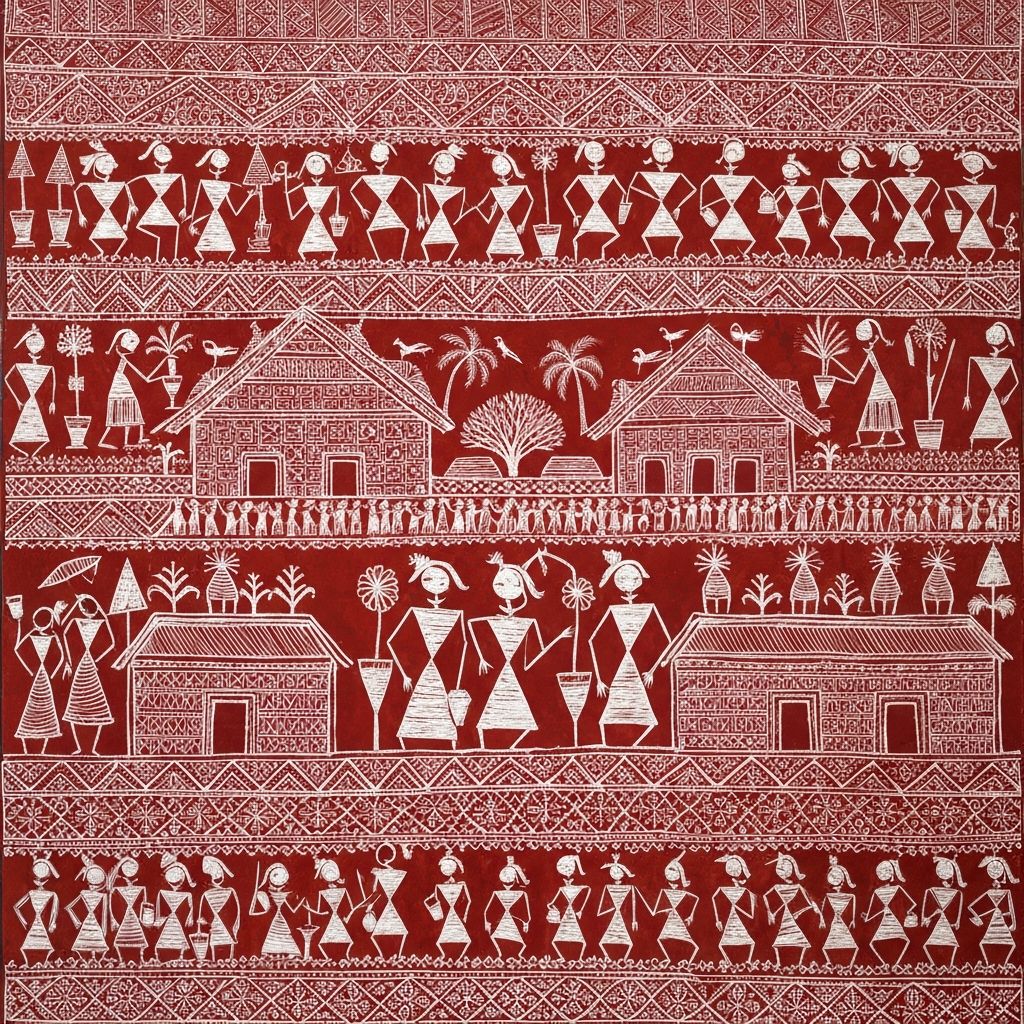
Warli Art
Simple geometry, profound stories - the visual language of Maharashtra's tribal communities.
Origin
Thane, Maharashtra
History
2500+ Years
Colors
White on Red/Brown
Community
Warli Tribe
Warli painting is one of the oldest forms of Indian art, originating with the Warli tribe in the northern Sahyadri range of Maharashtra. Dating back to 2500-3000 BCE, these paintings use basic geometric shapes to depict the daily life, rituals, and relationship with nature of the tribal community.
Traditionally painted on mud walls of tribal homes using rice paste on a red ochre background, Warli art was the domain of women who painted during festivals and weddings. The central motif of most traditional Warli paintings is the Chaukat - a square representing Palaghata, the mother goddess.
The beauty of Warli lies in its simplicity - stick figures made of triangles, circles, and lines come together to create complex narratives of hunting, farming, dancing, and celebration. This minimalist aesthetic has gained international recognition and inspired contemporary art and design.
Key Elements
Triangle
Basic unit representing mountains and humans
Circle
Symbolizing the sun, moon, and unity
Square
Representing sacred enclosures
Tarpa Dance
Signature spiral dance formation
Trees of Life
Central motif symbolizing nature
Animals
Deer, birds, and cattle depicting harmony
Traditional Materials
- Canvas: Mud walls coated with cow dung and red earth
- White Paint: Rice paste mixed with water and gum
- Brush: Bamboo stick chewed at one end
- Background: Red ochre earth mixed with cow dung