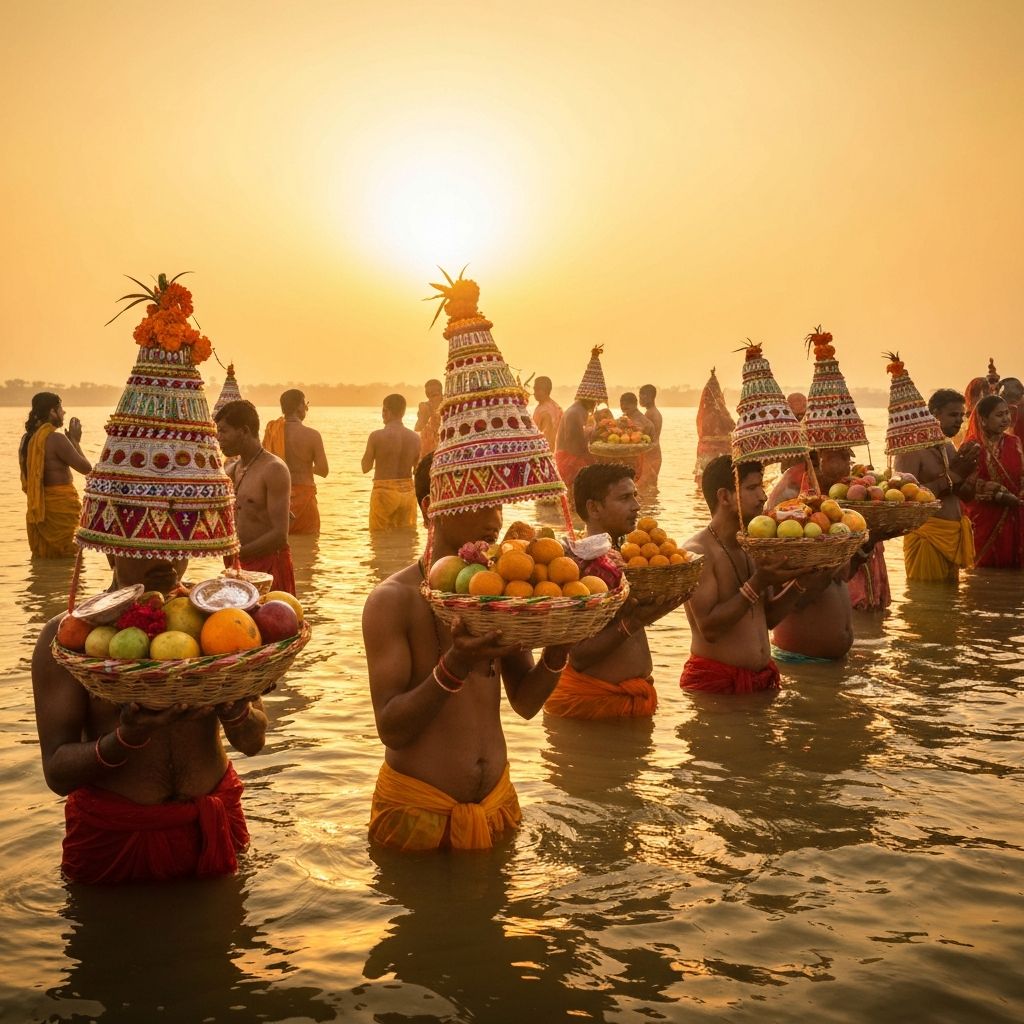
Chhath Puja
An ancient Hindu festival dedicated to Surya (Sun God) and Chhathi Maiya, celebrated with rigorous rituals and deep devotion in Bihar and eastern India.
When
October - November
Duration
4 Days
Celebrated In
Bihar, Jharkhand, UP
Significance
Sun Worship
Traditions
The Four Days of Chhath
Nahay Khay
Day 1Devotees take a holy bath and eat one meal of rice, dal, and pumpkin vegetables.
Kharna
Day 2A day-long fast ending with kheer (rice pudding) and roti after sunset.
Sandhya Arghya
Day 3Evening offerings to the setting sun while standing in water, the main celebration day.
Usha Arghya
Day 4Final offerings to the rising sun at dawn, followed by breaking of the fast.
Regional Celebrations
Bihar
The heartland of Chhath; grand celebrations at every river ghat and water body.
Jharkhand
Major festival with elaborate preparations and community celebrations.
Uttar Pradesh
Widely celebrated in eastern UP, especially along the Ganges.
Delhi
Large Bihari diaspora celebrates at Yamuna ghats and designated Chhath ghats.
The Significance of Chhath
Chhath Puja is one of the most ancient Hindu festivals, with references in the Rigveda. It is dedicated to Surya, the Sun God, who is considered the source of all energy on Earth. The festival also honors Chhathi Maiya, the sister of Surya, who grants wishes for prosperity and well-being.
The rituals of Chhath are remarkably austere. Devotees, mostly women, observe a strict 36-hour fast without water, stand in water bodies during sunset and sunrise, and make offerings to the sun. The discipline and devotion required make it one of the most rigorous Hindu festivals.
Chhath is unique in that it requires no priests - devotees perform all rituals themselves, making it a direct communion with the divine. The festival promotes cleanliness, as water bodies are cleaned before the celebration.
Preparing for Chhath Puja
- Clean the house and surroundings
- Prepare thekua and other prasad
- Arrange soop/daura (bamboo baskets)
- Identify a clean ghat or water body
- Gather sugarcane, fruits, and offerings
- Prepare new clothes for the rituals
- Learn traditional Chhath songs
- Mentally prepare for the strict fast