Holi
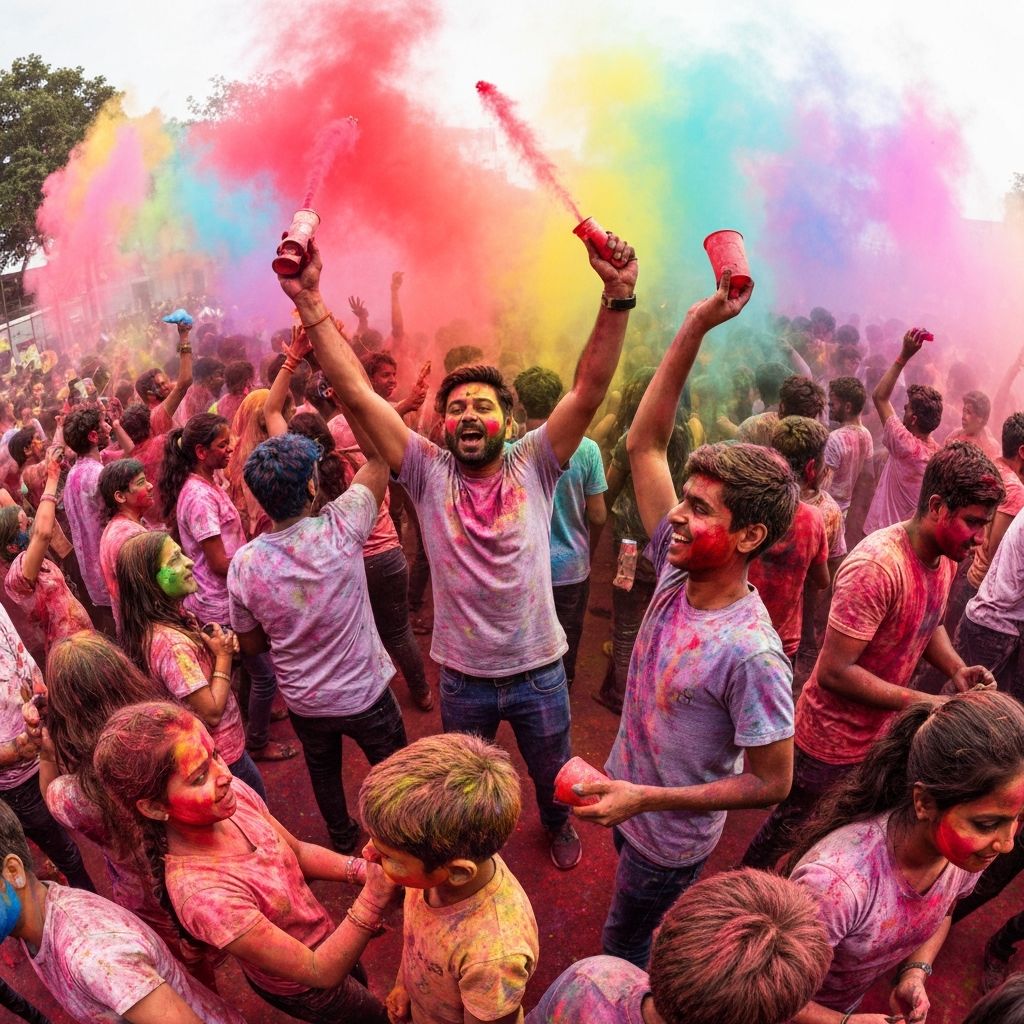
India's most exuberant spring festival — a joyous celebration of color, love, and the eternal victory of good over evil.
When
February - March
Duration
2 Days
Celebrated In
All of India
Significance
Arrival of Spring
Traditions
Colors & Their Meanings
- RedLove & Fertility
- YellowHappiness & Prosperity
- GreenNew Beginnings & Harvest
- BlueCalm & the Divine
- PinkPlayfulness & Joy
- OrangeCourage & Vitality
How Holi Unfolds
Holika Dahan
EveThe night before Holi, communities gather around large bonfires. The ritual symbolizes the story of Prahlad and Holika — the victory of devotion over evil.
Dhuleti (Rangwali Holi)
Day 1The main day of color play. Streets fill with people throwing gulal, spraying colored water, and celebrating with music and dance from morning until afternoon.
Dulandi / Panchami
Day 2In many regions, celebrations continue with family visits, sharing sweets, and applying a final touch of color as part of the extended festivities.
Regional Celebrations
Mathura & Vrindavan
The most vibrant Holi celebrations happen here over 16 days, including the famous Lathmar Holi where women playfully beat men with sticks.
Barsana (UP)
Lathmar Holi is a unique tradition where women of Barsana chase men from Nandgaon, recreating the legend of Radha and Krishna.
West Bengal
Celebrated as Dol Yatra or Dol Purnima, with processions carrying idols of Radha-Krishna and singing of Rabindranath Tagore's songs.
Punjab & Haryana
Celebrated with immense energy, including grand bonfires, bhangra dancing, and the Hola Mohalla martial festival near Anandpur Sahib.
The Story of Holi
The most ancient legend behind Holi is that of Prahlad and Holika. Prahlad, a devoted follower of Lord Vishnu, was the son of the demon king Hiranyakashipu, who despised his son's devotion. Hiranyakashipu ordered his sister Holika — who had a boon of immunity from fire — to sit in a bonfire with Prahlad on her lap. Instead, Holika was burned to ashes while Prahlad emerged unharmed, protected by his unwavering faith.
Another legend integral to Holi is the playful love between Radha and Krishna. The young Krishna, with his characteristic dark complexion, was jealous of Radha's fair skin. His mother Yashoda playfully suggested he color Radha's face — and so began the tradition of applying color. The Braj region (Mathura, Vrindavan, Barsana) continues to celebrate this spirit with its world-famous Lathmar Holi.
Holi also marks the seasonal transition — the passing of winter and the embrace of spring's abundance. Ancient texts like the Puranas, Ratnavali by Harsha, and carvings on stone temples at Vijayanagara depict Holi celebrations, confirming its deep roots across millennia of Indian civilization.
Preparing for Holi
- Apply coconut or mustard oil on skin before playing
- Use natural, organic colors to protect skin and eyes
- Wear old white or light-colored clothes
- Keep a change of clothes ready
- Prepare gujiya and thandai the day before
- Protect hair with oil or a head covering
- Stay hydrated throughout the day
- Light the Holika Dahan bonfire the evening before