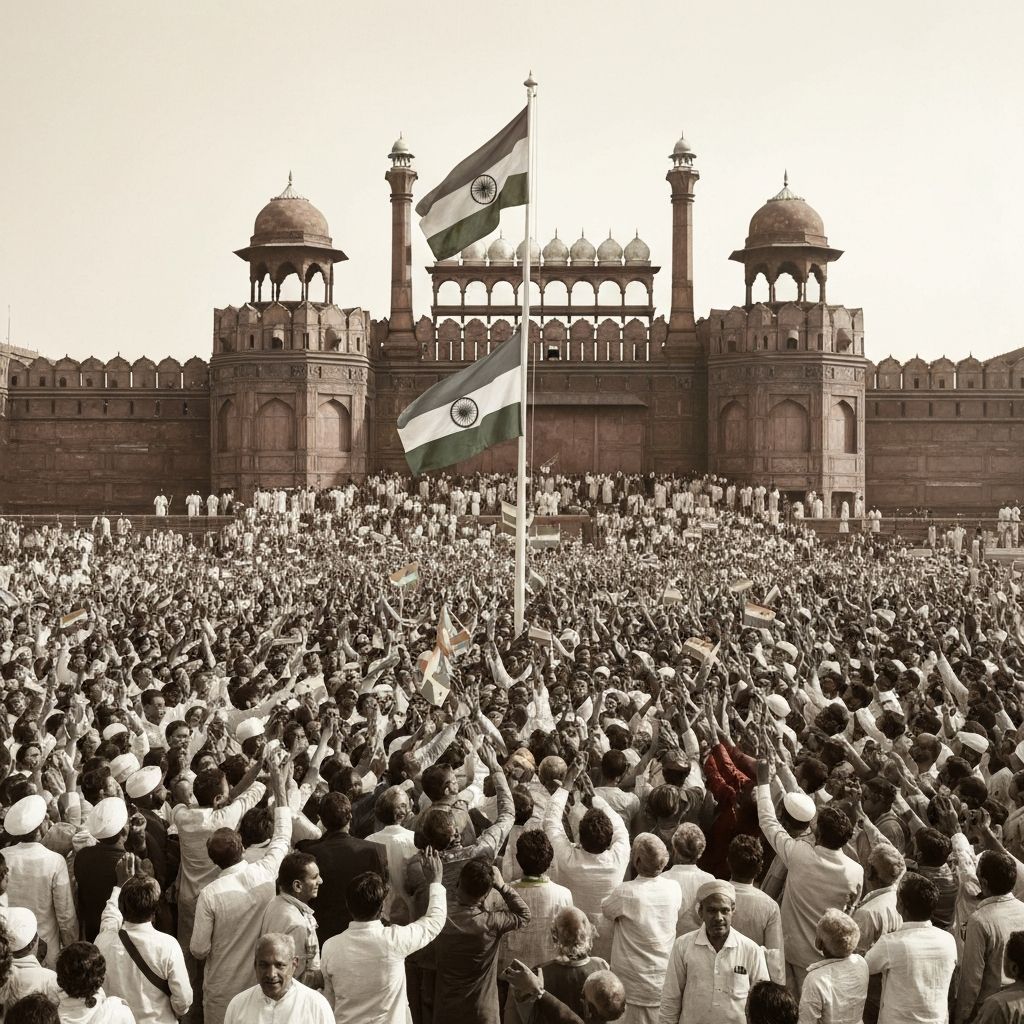
Indian Freedom Movement
The epic struggle for independence that transformed a colonial possession into the world's largest democracy, led by visionaries who chose truth and non-violence as their weapons against the mightiest empire of the age.
Region
Indian Subcontinent
Period
1857 - 1947 CE
Key Figures
Rani Lakshmibai, Mahatma Gandhi
Outcome
Independence 1947
The Indian Freedom Movement stands as one of history's most remarkable struggles for self-determination. Spanning nearly a century, it witnessed the awakening of a nation of 400 million people who, through the power of non-violent resistance, brought the mighty British Empire to negotiate terms of withdrawal.
This was not merely a political movement but a moral and spiritual revolution that gave the world new methods of resistance and proved that truth and righteousness could triumph over military might. The movement produced leaders whose ideas continue to inspire struggles for justice and freedom around the world.
The Revolt of 1857: The First Spark
The Indian Rebellion of 1857, often called the First War of Independence, marked the beginning of organized resistance against British rule. What started as a mutiny among Indian soldiers (sepoys) of the British East India Company quickly spread into a widespread civilian uprising across northern and central India.
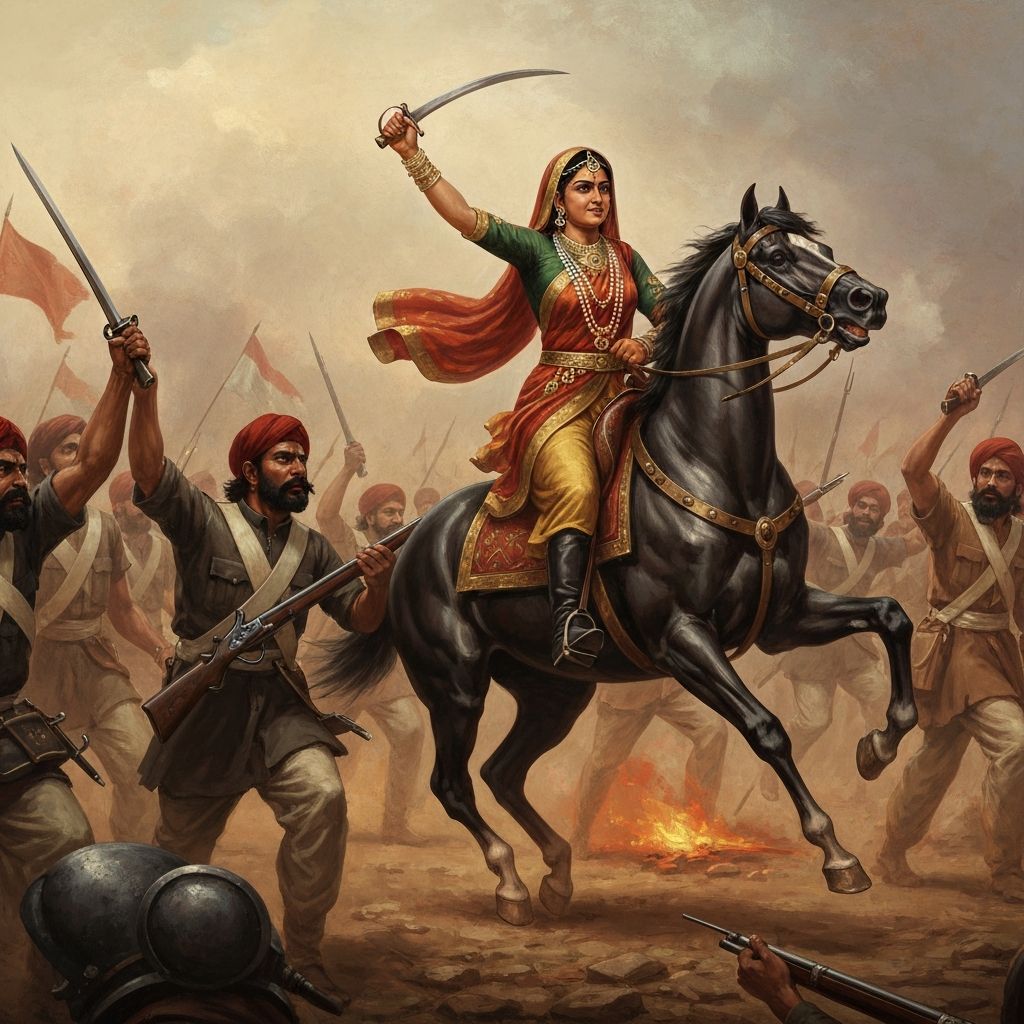
Rani Lakshmibai of Jhansi - one of the leading figures of the 1857 rebellion
The revolt saw the emergence of legendary figures like Rani Lakshmibai of Jhansi, Tantia Tope, Mangal Pandey, and Bahadur Shah Zafar. Though ultimately suppressed, it shook the foundations of British rule and led to the dissolution of the East India Company, with the British Crown assuming direct control of India.
Heroes of 1857
- Rani Lakshmibai - Queen of Jhansi who died fighting on the battlefield
- Mangal Pandey - The sepoy whose defiance sparked the rebellion
- Bahadur Shah Zafar - Last Mughal emperor, symbol of the uprising
- Tantia Tope - Military leader who continued guerrilla resistance
The Rise of Indian Nationalism
The latter half of the 19th century saw the emergence of organized political consciousness. The Indian National Congress, founded in 1885, became the primary vehicle for nationalist aspirations. Early moderates like Dadabhai Naoroji, Gopal Krishna Gokhale, and Pherozeshah Mehta advocated for gradual reform through constitutional means.
The partition of Bengal in 1905 by Lord Curzon sparked a more militant phase. Leaders like Bal Gangadhar Tilak, Bipin Chandra Pal, and Lala Lajpat Rai - known as Lal-Bal-Pal - advocated for Swaraj (self-rule) and launched the Swadeshi movement, encouraging boycott of British goods and promotion of Indian industries.
"Swaraj is my birthright, and I shall have it!"
— Bal Gangadhar Tilak
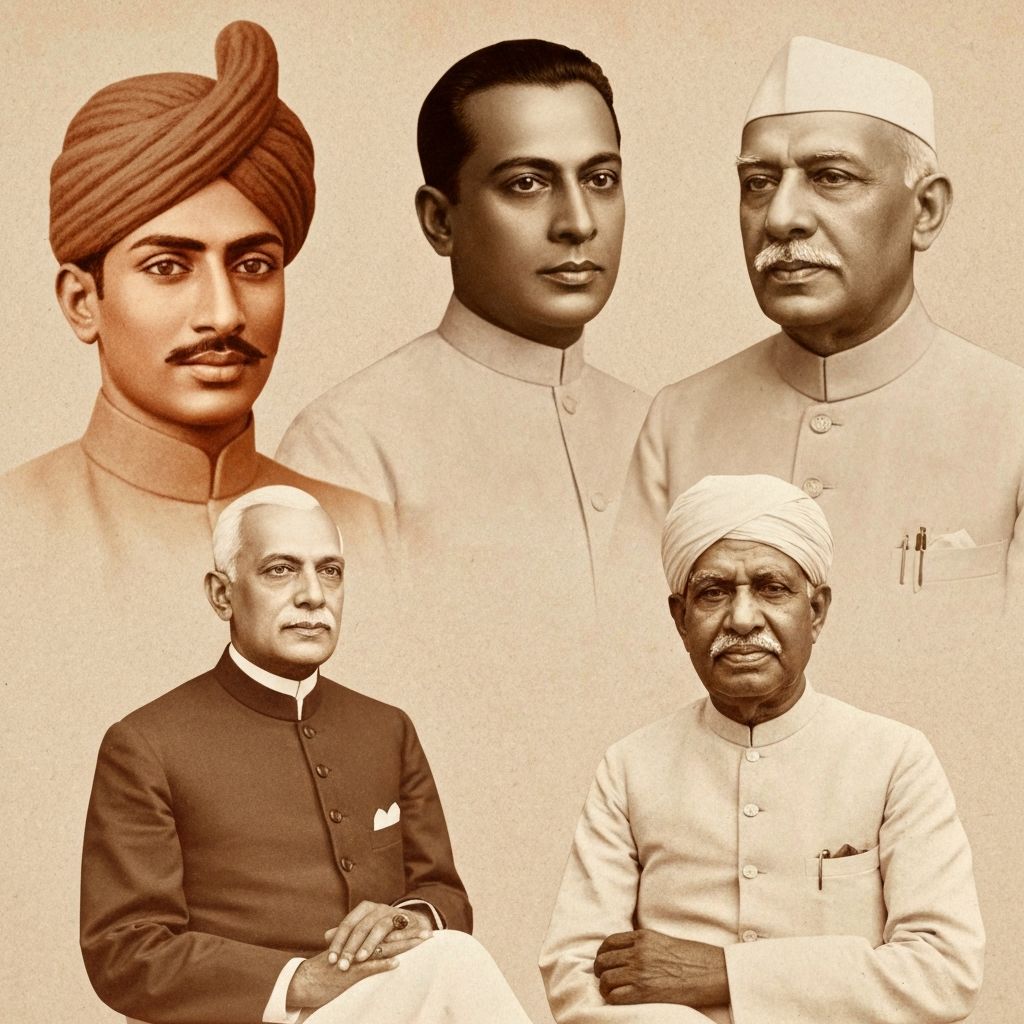
Leaders who shaped the freedom movement through different approaches
Mahatma Gandhi and the Philosophy of Non-Violence
Mohandas Karamchand Gandhi returned to India in 1915 after two decades in South Africa, where he had developed his philosophy of Satyagraha - truth-force or non-violent resistance. His arrival transformed the freedom movement from an elite political campaign into a mass movement involving millions of ordinary Indians.
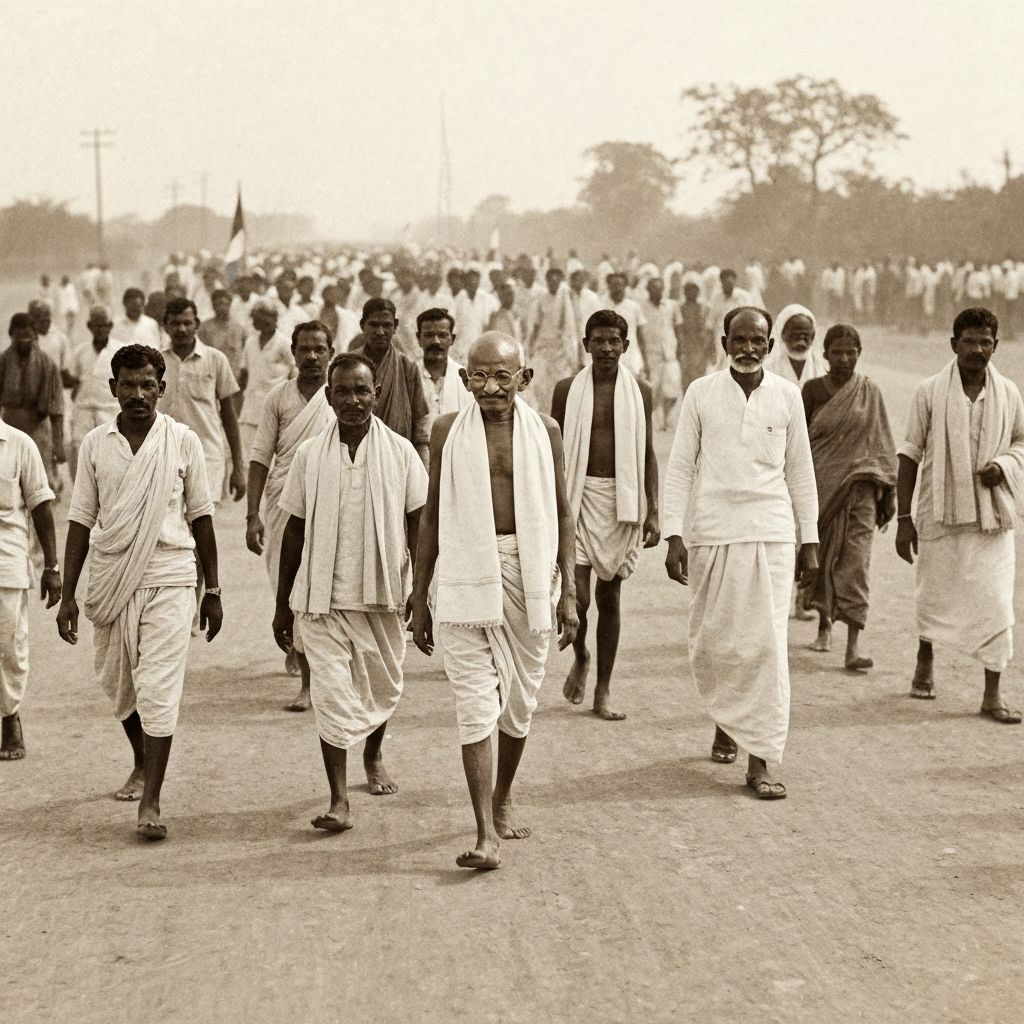
Gandhi leading the historic Salt March to Dandi, 1930 - a defining moment of civil disobedience
Gandhi's genius lay in identifying issues that could unite Indians across regions, religions, and classes. The Non-Cooperation Movement (1920-22), the Salt March (1930), and the Quit India Movement (1942) mobilized unprecedented numbers of people in peaceful resistance against colonial rule.
"First they ignore you, then they laugh at you, then they fight you, then you win."
— Attributed to Mahatma Gandhi
Major Satyagraha Movements
- Champaran (1917) - Gandhi's first Satyagraha in India for indigo farmers
- Non-Cooperation (1920-22) - Mass boycott of British institutions and goods
- Salt March (1930) - 240-mile march challenging the British salt monopoly
- Quit India (1942) - Final push demanding immediate British withdrawal
The Revolutionary Path
While Gandhi's non-violent movement dominated the mainstream, a parallel revolutionary movement pursued armed resistance. Young revolutionaries like Bhagat Singh, Chandrashekhar Azad, and Sukhdev chose to sacrifice their lives to awaken the nation and shake the foundations of British rule.
Subhas Chandra Bose, who had risen to become Congress President, broke with Gandhi over strategy. He escaped British surveillance, reached Germany and Japan, and formed the Indian National Army (INA) with Indian prisoners of war. His call "Give me blood, and I shall give you freedom" inspired thousands to take up arms.
"They may kill me, but they cannot kill my ideas. They can crush my body, but they will not be able to crush my spirit."
— Bhagat Singh
Revolutionary Heroes
- Bhagat Singh - Martyred at 23, became a symbol of youth sacrifice
- Subhas Chandra Bose - Formed INA to liberate India through armed struggle
- Chandrashekhar Azad - Revolutionary who vowed never to be captured alive
- Ashfaqulla Khan - Revolutionary who gave his life for Hindu-Muslim unity
Quit India: The Final Push
On August 8, 1942, at the Bombay session of the Congress, Gandhi launched the Quit India Movement with the clarion call "Do or Die." The British responded by immediately arresting Gandhi and the entire Congress leadership, but this only inflamed the masses.
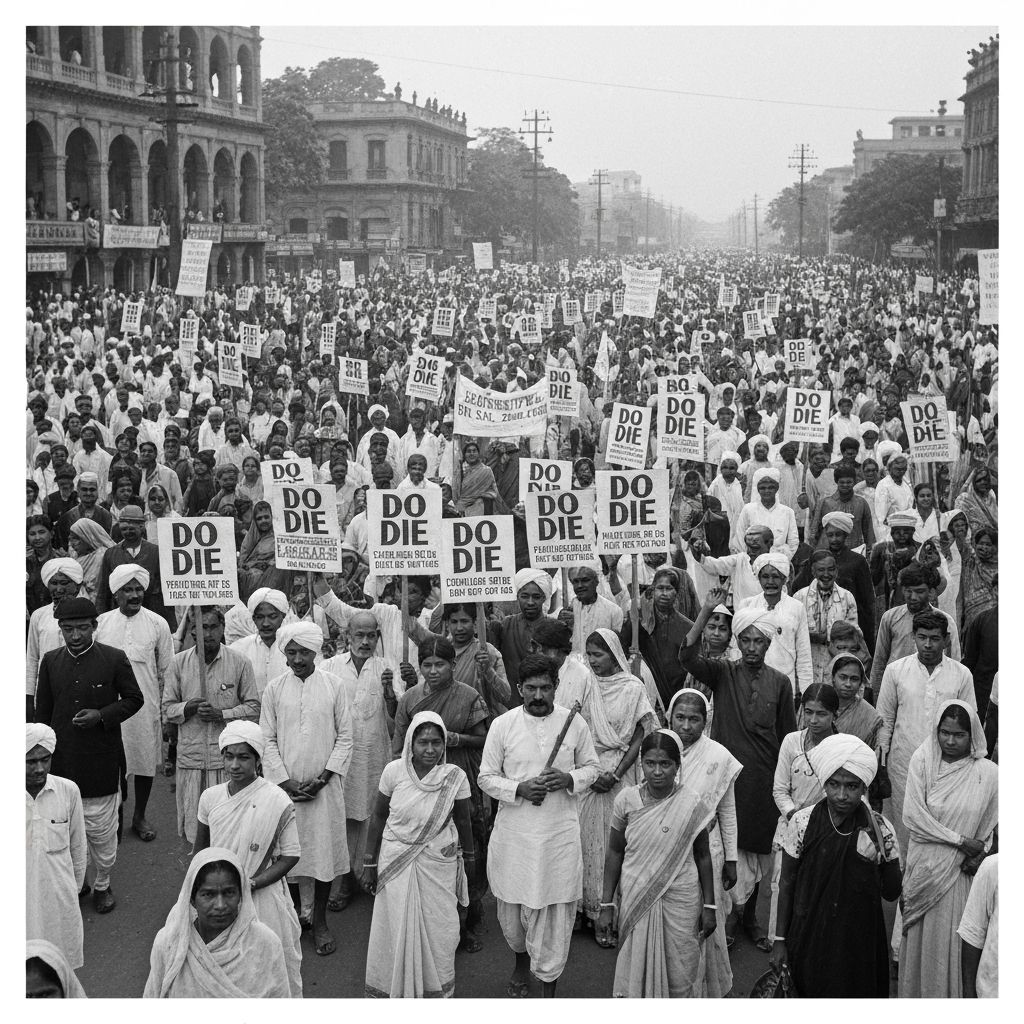
The Quit India Movement (1942) - the final mass uprising against British rule
What followed was the most widespread uprising since 1857. Despite brutal repression that saw over 100,000 arrests and hundreds killed, the movement demonstrated that British rule could no longer be sustained. World War II had weakened Britain, and the writing was on the wall.
"Here is a mantra, a short one, that I give you. You may imprint it on your hearts and let every breath of yours give expression to it. The mantra is: 'Do or Die.'"
— Mahatma Gandhi, August 8, 1942
Independence and the Tragedy of Partition
After World War II, the weakened British government sent the Cabinet Mission in 1946 to negotiate India's independence. Negotiations between the Congress, Muslim League, and the British eventually led to the decision to partition India along religious lines.
On August 15, 1947, India achieved independence, but the joy was marred by the tragedy of Partition. The creation of India and Pakistan led to one of history's largest mass migrations, with an estimated 10-20 million people displaced and up to 2 million killed in communal violence. Gandhi, who had worked all his life for Hindu-Muslim unity, spent Independence Day fasting in Calcutta to stop the riots.
Road to Independence
The Enduring Legacy
The Indian Freedom Movement's legacy extends far beyond India's borders. Gandhi's philosophy of non-violent resistance inspired civil rights movements worldwide - from Martin Luther King Jr. in America to Nelson Mandela in South Africa to the Solidarity movement in Poland.
The leaders of the freedom movement became the architects of modern India. Jawaharlal Nehru shaped India's democratic institutions and foreign policy. Sardar Vallabhbhai Patel unified 562 princely states into the Indian Union. B.R. Ambedkar drafted the Constitution that guaranteed fundamental rights to all citizens.
"Long years ago we made a tryst with destiny, and now the time comes when we shall redeem our pledge, not wholly or in full measure, but very substantially. At the stroke of the midnight hour, when the world sleeps, India will awake to life and freedom."
— Jawaharlal Nehru, August 14, 1947
Lasting Contributions
- Non-violent resistance - A new paradigm for fighting oppression adopted worldwide
- Democratic constitution - Largest democracy with universal adult franchise from day one
- Secularism - Constitutional commitment to religious pluralism
- Anti-colonialism - Inspired independence movements across Asia and Africa
- Social reform - Movements against untouchability, for women's rights, and education
The freedom struggle taught India that diverse people could unite for a common cause while respecting their differences. This principle of unity in diversity became the foundation of the Indian nation. The sacrifices of countless known and unknown freedom fighters remind each generation of the price paid for liberty and the responsibility to preserve and perfect the democracy they won.