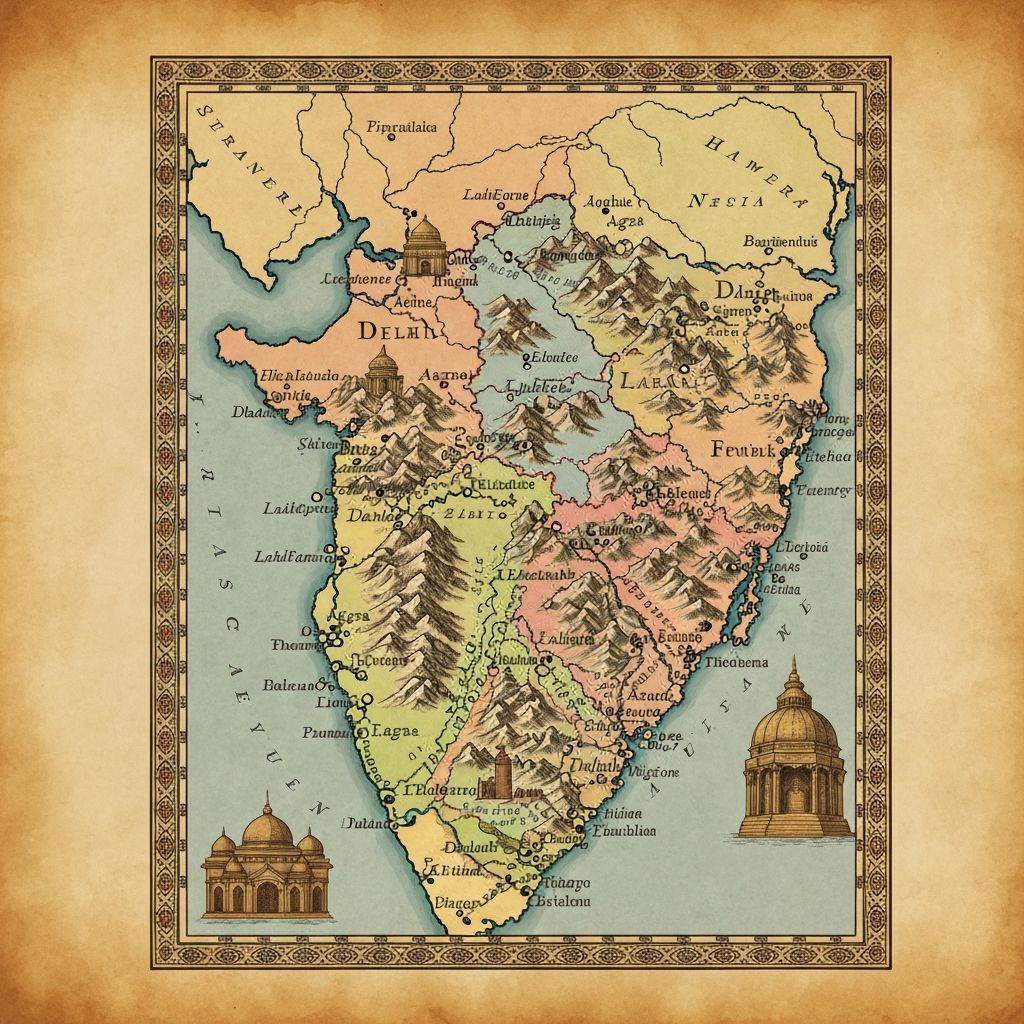
The Mughal Empire
From the steppes of Central Asia to the throne of Hindustan — the Mughals created one of history's most magnificent empires, leaving behind architectural wonders, a rich artistic legacy, and a model of cultural synthesis that shaped the Indian subcontinent for centuries.
Region
Indian Subcontinent
Period
1526 - 1857 CE
Peak Period
1556 - 1707 CE
Capital
Delhi, Agra
Origins: The Coming of the Mughals
The Mughal Empire was founded by Zahir ud-Din Muhammad Babur, a prince descended from both Timur (Tamerlane) and Genghis Khan. Driven from his ancestral homeland of Fergana in Central Asia, Babur turned his ambitions toward the rich plains of Hindustan. In 1526, at the First Battle of Panipat, his small but disciplined army, equipped with matchlock firearms and field artillery, defeated the vastly larger forces of Ibrahim Lodi, the last Sultan of Delhi.
Babur was not merely a conqueror but a cultured man of letters. His autobiography, the Baburnama, written in Chagatai Turkic, remains one of the great memoirs of world literature — a candid, observant account of his adventures, his love of gardens and nature, and his assessments of India's people and landscape.
The Six Notable Mughals
The empire reached its zenith under six successive emperors, known as the "Great Mughals":
- Babur (r. 1526-1530) — The Founder
- Humayun (r. 1530-1556) — The Wanderer
- Akbar (r. 1556-1605) — The Great
- Jahangir (r. 1605-1627) — The Connoisseur
- Shah Jahan (r. 1628-1658) — The Builder
- Aurangzeb (r. 1658-1707) — The Austere
Akbar the Great: Architect of Empire
It was Akbar, Babur's grandson, who transformed the Mughal realm from a Central Asian conquest into a truly Indian empire. Ascending the throne at just thirteen years of age in 1556, Akbar would reign for nearly fifty years, creating administrative systems and cultural institutions that would endure long after the empire's decline.
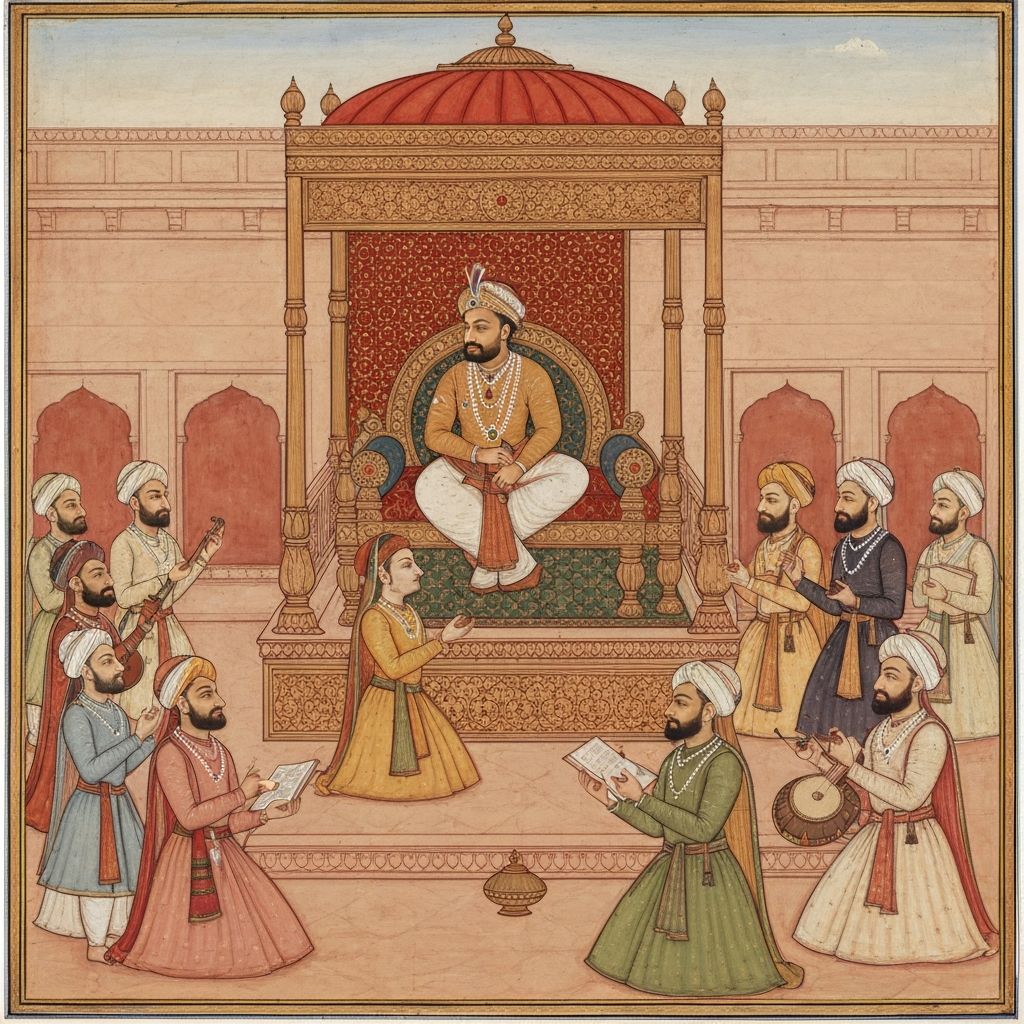
The court of Akbar the Great — a gathering place for scholars of all faiths and traditions
Akbar's genius lay in his policy of sulh-i-kul— "peace with all" — a revolutionary approach to governance in a religiously diverse land. He abolished the jizya (tax on non-Muslims), married Rajput princesses and elevated Hindu nobles to the highest positions, and established the Ibadat Khana (House of Worship) at Fatehpur Sikri where scholars of all religions — Muslims, Hindus, Christians, Jains, Zoroastrians, and even atheists — debated theology and philosophy.
"No man should be interfered with on account of religion, and anyone is to be allowed to go over to a religion that pleases him."
— Emperor Akbar
His administrative reforms were equally visionary. The mansabdari system organized the nobility and military into a unified hierarchy based on rank rather than birth. The land revenue system developed by his finance minister Todar Mal created detailed records of agricultural production and fair tax assessments that remained the foundation of Indian revenue administration well into British times.
Architecture: Building for Eternity
The Mughals were history's great builders. Combining Persian, Central Asian, and Indian architectural traditions, they created a distinctive style characterized by massive scale, geometric precision, and exquisite decorative detail. Their monuments — built of red sandstone, white marble, and precious stone inlay — were designed not merely as functional spaces but as statements of imperial power and artistic refinement.
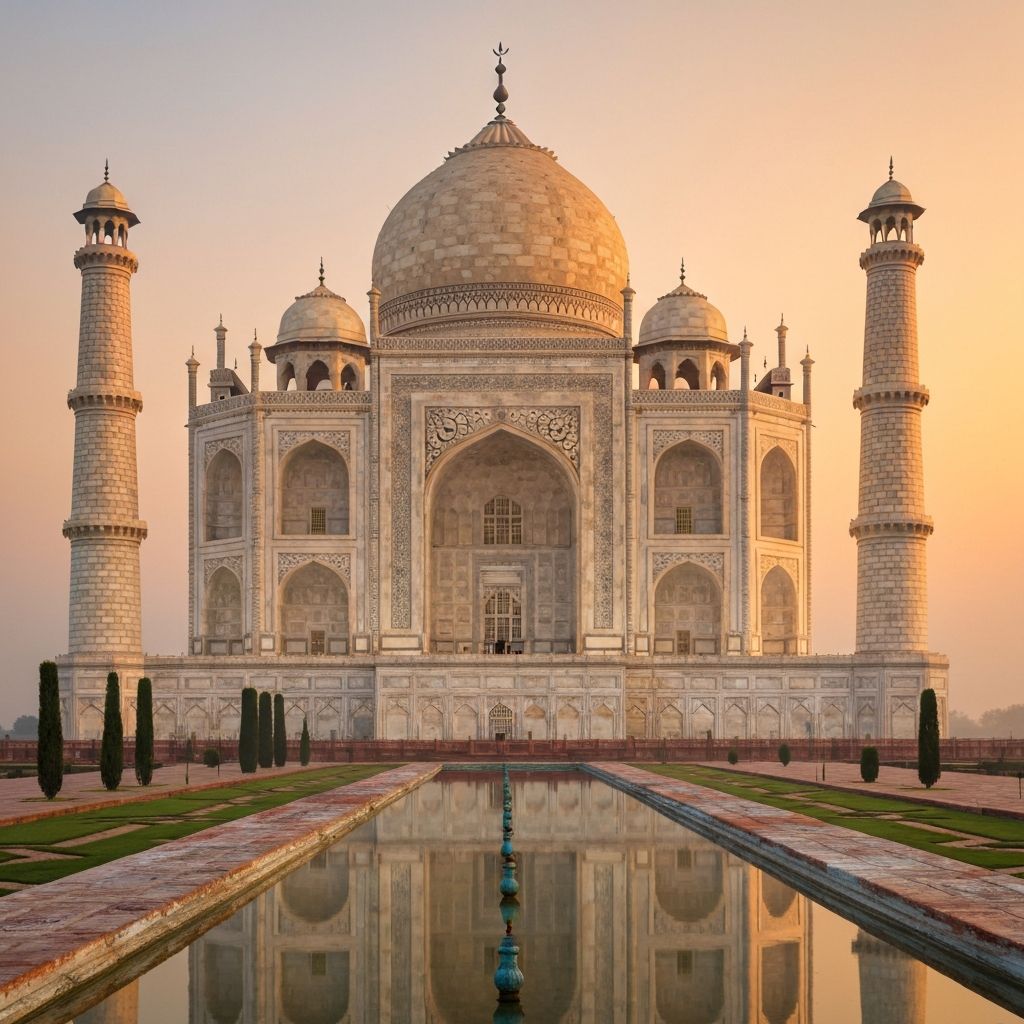
The Taj Mahal — Shah Jahan's monument to love, considered the finest example of Mughal architecture
The apex of Mughal architecture came under Shah Jahan, who rebuilt much of Delhi and Agra in gleaming white marble. The Taj Mahal, built as a mausoleum for his beloved wife Mumtaz Mahal, took 22 years and 20,000 workers to complete. Its perfect proportions, luminous marble surfaces, and intricate pietra dura(stone inlay) work have made it one of the world's most recognized and admired buildings.
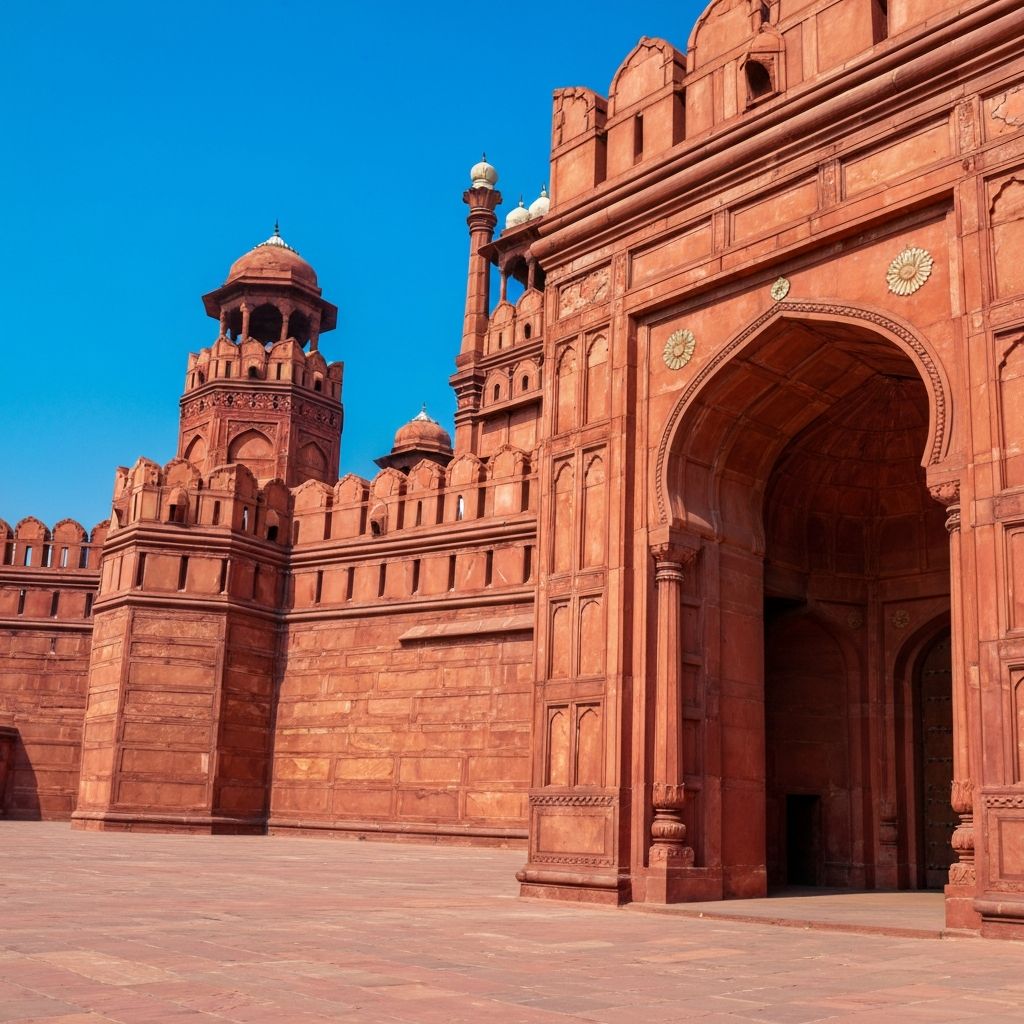
The Red Fort of Delhi — the seat of Mughal power and symbol of India's independence
Masterpieces of Mughal Architecture
- Humayun's Tomb, Delhi — The first great Mughal garden tomb, prototype for the Taj Mahal
- Fatehpur Sikri — Akbar's planned capital, a masterpiece of red sandstone
- Agra Fort — A massive fortress-palace complex on the Yamuna River
- Jama Masjid, Delhi — India's largest mosque, built by Shah Jahan
- Shalimar Gardens, Lahore — The finest example of Mughal garden design
Art, Literature, and Culture
The Mughal court was a great patron of the arts, fostering a brilliant cultural flowering that fused Persian, Indian, and Central Asian traditions into something wholly new. Mughal miniature painting reached heights of technical mastery and emotional depth unmatched anywhere in the world, depicting court scenes, portraits, nature studies, and illustrations of literary classics with exquisite detail and vibrant color.
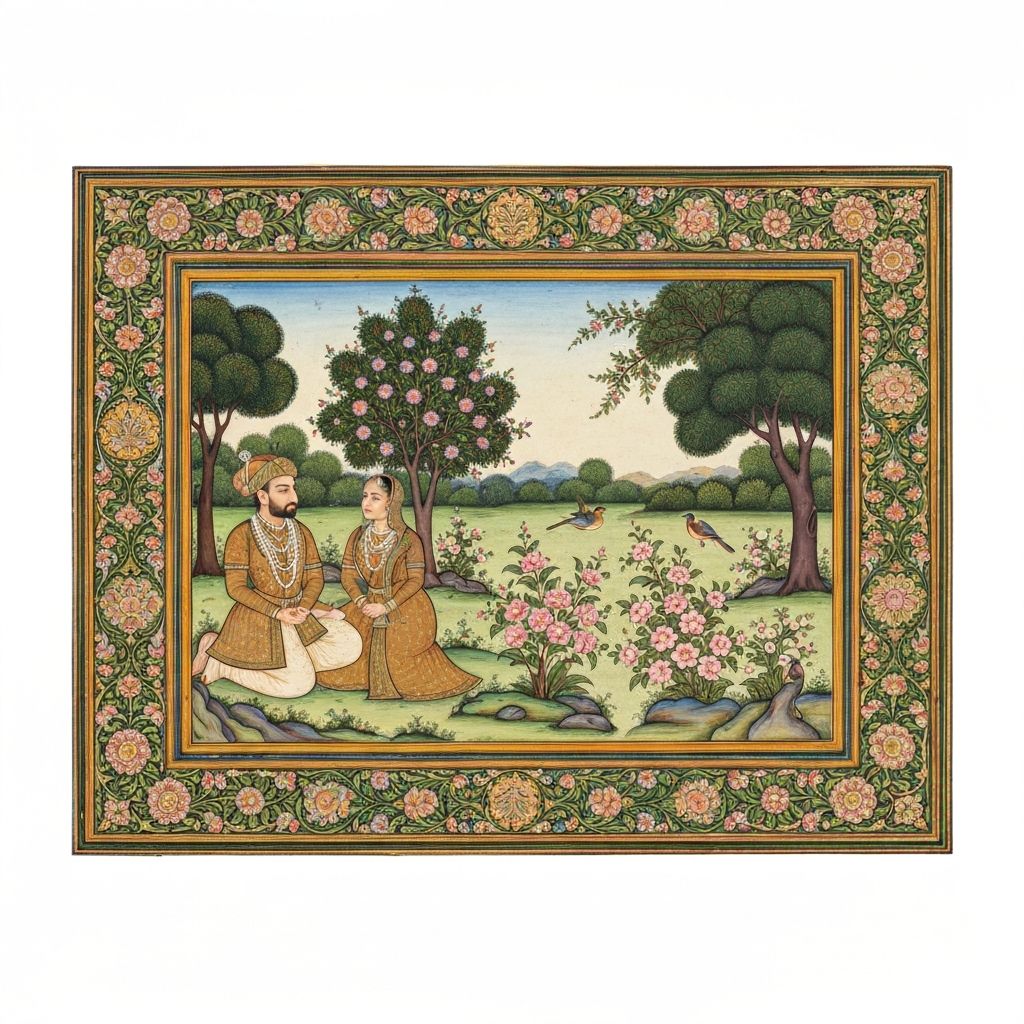
Mughal miniature painting — a fusion of Persian refinement and Indian vibrancy
Under Akbar, the imperial workshops produced illustrated manuscripts of extraordinary beauty, including the Hamzanama (Adventures of Amir Hamza) with 1,400 large-format paintings, and the Akbarnama, the official chronicle of his reign. Jahangir, himself an accomplished naturalist, commissioned paintings of plants and animals of scientific accuracy, while Shah Jahan's artists perfected the imperial portrait.
Persian was the language of the court, but the Mughals also patronized Hindi and Sanskrit literature. The interaction of Persian and local languages gave birth to Urdu, a new literary language that would become one of the subcontinent's most expressive poetic traditions. Music flourished under imperial patronage, with the legendary Tansen serving at Akbar's court and helping to codify the classical Hindustani tradition.
"If there be paradise on earth, it is this, it is this, it is this."
— Inscription in the Diwan-i-Khas, Red Fort, Delhi
Economy and Trade
The Mughal Empire presided over one of the largest economies in the early modern world. At its peak under Aurangzeb, it controlled nearly a quarter of global GDP. Indian textiles — cotton muslins, chintzes, and silk brocades — were exported across the world, from the courts of Europe to the markets of Southeast Asia and Africa. The demand was so great that European trading companies, unable to offer goods Indians wanted in exchange, paid in silver, causing a massive flow of precious metal into the subcontinent.
Centers of Mughal Commerce
Major Trading Cities
- • Surat — Gateway to overseas trade
- • Dhaka — Center of muslin production
- • Ahmedabad — Textile manufacturing hub
- • Multan — Caravan trade terminus
Key Exports
- • Fine cotton textiles and muslins
- • Indigo, saltpeter, and spices
- • Silk and brocade fabrics
- • Precious stones and jewelry
Decline and Fall
The seeds of decline were sown even as the empire reached its greatest territorial extent under Aurangzeb (r. 1658-1707). His endless wars of expansion in the Deccan drained the treasury. His reversal of Akbar's policies of religious tolerance — reimposing the jizya and destroying Hindu temples — alienated the Rajput allies and provoked fierce resistance from the Marathas, the Sikhs, and the Jats.
After Aurangzeb's death in 1707, the empire fragmented rapidly. Weak successors fought civil wars while regional governors declared independence. The Marathas rose to dominate central India, the Sikhs carved out a kingdom in Punjab, and the Nizam established himself in Hyderabad. In 1739, the Persian conqueror Nadir Shah sacked Delhi and carried away the Peacock Throne and the Koh-i-Noor diamond, a blow from which Mughal prestige never recovered.
Key Moments
Timeline of Decline
The fall of a great empire
Death of Aurangzeb
Succession wars begin after emperor's death
Sack of Delhi
Nadir Shah's devastating invasion
Battle of Plassey
British dominance begins in India
Delhi Falls
Delhi falls to the British East India Company
Indian Rebellion
Last Mughal emperor exiled to Rangoon
The final Mughal emperor, Bahadur Shah Zafar II, was a poet with no real power, ruling only the Red Fort while the British controlled his realm. In 1857, the sepoys of the great rebellion proclaimed him Emperor of India, but the uprising was crushed. Bahadur Shah was tried for treason, and the last Mughal died in exile in Rangoon in 1862, ending a dynasty that had ruled for over three centuries.
Legacy and Continuity
The Mughal legacy pervades modern South Asia. Their architectural masterpieces — the Taj Mahal, Red Fort, and countless mosques, gardens, and tombs — remain the region's most iconic monuments. Mughal cuisine, with its rich biryanis, kebabs, and kormas, defines fine dining across the subcontinent. The artistic traditions they fostered continue in miniature painting, calligraphy, and textile design.
More profoundly, the Mughals created a model of multicultural governance. Akbar's vision of an empire where people of all faiths could rise to the highest positions, where religious dialogue was encouraged and forced conversion forbidden, remains inspirational. The syncretic culture they fostered — blending Persian elegance with Indian richness — created traditions of music, poetry, and art that transcended religious boundaries.
"The Mughals gave India a sense of unity and a rich cultural synthesis. They showed that diversity could be a source of strength rather than division."
— Historian Abraham Eraly
Today, Urdu poetry and ghazals, Hindustani classical music, and the composite culture of cities like Delhi, Lucknow, and Hyderabad all bear the Mughal imprint. The Red Fort, from whose ramparts India's prime ministers address the nation each Independence Day, symbolizes the continuity between Mughal India and the modern republic. The empire is gone, but its cultural contributions endure as a testament to one of history's most creative civilizations.