Bhagavad Gita
The Song of God — a 700-verse dialogue between Krishna and Arjuna on the battlefield of Kurukshetra, offering timeless wisdom on duty, action, and the path to liberation.
Composed
c. 200 BCE – 200 CE
Structure
18 Chapters, 700 Verses
Read Time
10 min read
On a battlefield where armies stand poised for the most devastating war in Indian memory, a warrior refuses to fight. In the space between two great armies, between life and death, between duty and despair, unfolds the most celebrated philosophical dialogue in Hindu tradition — the Bhagavad Gita, the Song of God.
The Setting: Kurukshetra
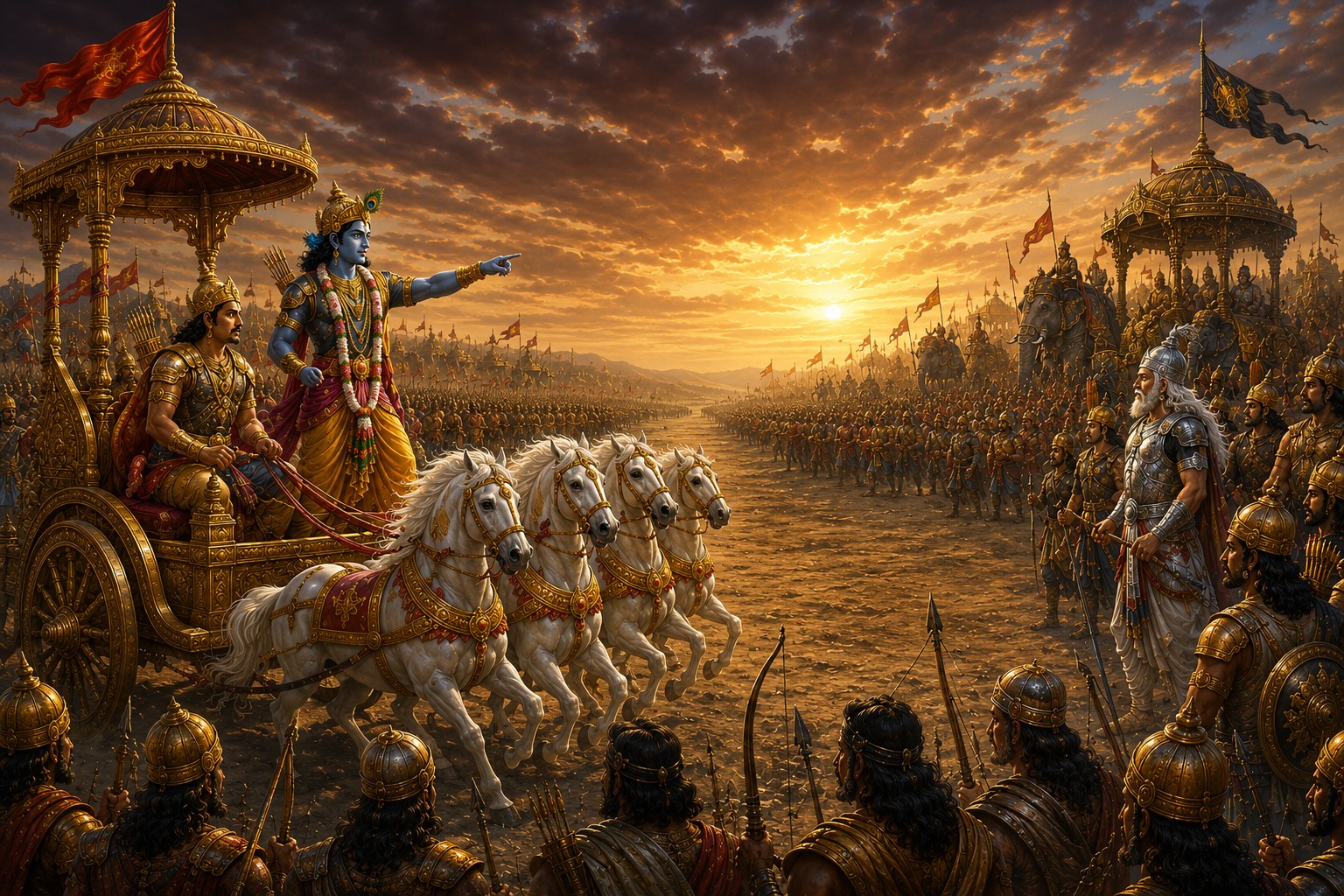
The Gita is set within the vast epic of the Mahabharata, at the moment when the great war between the Pandavas and Kauravas is about to begin. Prince Arjuna, the greatest archer of his age, asks his charioteer Krishna to drive his chariot between the two armies. There, seeing his teachers, grandfathers, cousins, and friends arrayed on both sides, Arjuna is overwhelmed by grief and confusion. He drops his bow and declares he will not fight.
It is in this moment of existential crisis — when a man of action is paralysed by the implications of his action — that Krishna begins to speak. The 700 verses that follow constitute the Bhagavad Gita.
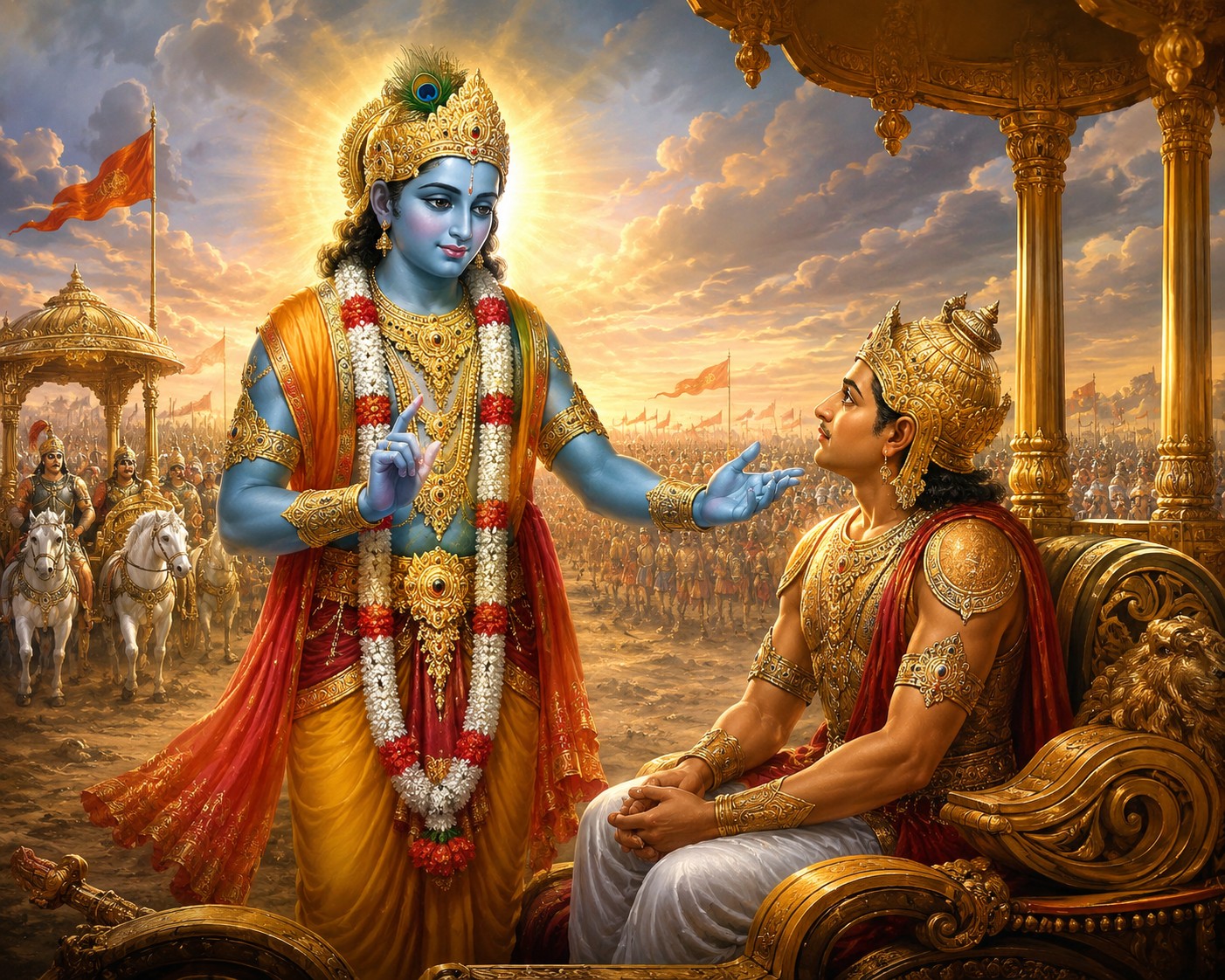
Krishna reveals divine wisdom to Arjuna on the battlefield of Kurukshetra
The Three Yogas
The Gita synthesises multiple paths to liberation, presenting them not as competing alternatives but as complementary approaches suited to different temperaments:
The Paths to Liberation
- Karma Yoga: The path of selfless action. One performs one's duty without attachment to results, offering all actions to the Divine. 'You have the right to action alone, never to its fruits.'
- Jnana Yoga: The path of knowledge. Through discrimination between the real and unreal, the eternal and temporal, the seeker realises the Self as distinct from body and mind.
- Bhakti Yoga: The path of devotion. Through love and surrender to the Divine, the devotee attains union. 'Fix your mind on Me, be devoted to Me, worship Me, bow down to Me.'
The Structure: 18 Chapters
The Gita unfolds across 18 chapters, each called a "yoga" — a discipline or path. The teaching progresses from Arjuna's despair through various philosophical expositions to the final call for surrender and action.
Arjuna Vishada Yoga
Chapter 1 · 47 verses
Arjuna's despair and moral crisis on the battlefield of Kurukshetra. Seeing his teachers, relatives, and friends arrayed against him, he drops his bow and refuses to fight.
Sankhya Yoga
Chapter 2 · 72 verses
Krishna begins his teaching with the immortality of the soul, the nature of the Self, and the philosophy of Sankhya. Contains the famous verses on the eternal Atman.
Karma Yoga
Chapter 3 · 43 verses
The yoga of selfless action. Krishna teaches that one must act without attachment to results, performing duty for its own sake.
Jnana Karma Sannyasa Yoga
Chapter 4 · 42 verses
The yoga of knowledge and renunciation of action. Krishna reveals the ancient lineage of this teaching and his divine incarnations.
Karma Sannyasa Yoga
Chapter 5 · 29 verses
Renunciation versus action. Krishna reconciles the path of renunciation with the path of selfless action.
Dhyana Yoga
Chapter 6 · 47 verses
The yoga of meditation. Detailed instructions on meditation practice, posture, and the qualities of a true yogi.
...and 12 more chapters exploring divine manifestations, the three gunas, the field and knower, devotion, liberation, and the final teachings.
The Cosmic Vision
In Chapter 11, Arjuna asks to see Krishna's true form. What follows is one of the most dramatic passages in world literature — the Vishvarupa Darshana, the vision of the Universal Form. Arjuna sees the entire cosmos contained within Krishna — all beings, all worlds, past and future, creation and destruction, gods and demons, all unified in one inconceivable divine body. Terrified and awestruck, Arjuna begs Krishna to return to his familiar human form.
"Whenever righteousness declines and unrighteousness rises, I manifest myself. For the protection of the good, for the destruction of evil, and for the establishment of dharma, I am born in every age."
The Enduring Message
The Gita's genius lies in its synthesis. It validates action in the world while pointing to transcendence. It honours multiple paths while insisting on single-pointed devotion. It acknowledges the reality of war and death while revealing the deathless Self. Its message is not withdrawal from life but engagement with life in a spirit of offering — acting fully, caring deeply, yet holding results lightly.
Across centuries, the Gita has been commented upon by nearly every major Indian philosopher — Shankara, Ramanuja, Madhva, Abhinavagupta — each finding in it confirmation of their own understanding. In modern times, it inspired Mahatma Gandhi's philosophy of nonviolent action and continues to be one of the most translated and studied spiritual texts in the world.
The Gita ends as it began — on the battlefield, with the armies still waiting. But Arjuna is transformed. "My delusion is destroyed," he tells Krishna. "By your grace, my memory is restored. I stand firm, free from doubt. I will do your bidding." The dialogue is complete. The war is about to begin. And the eternal teachings have been spoken.