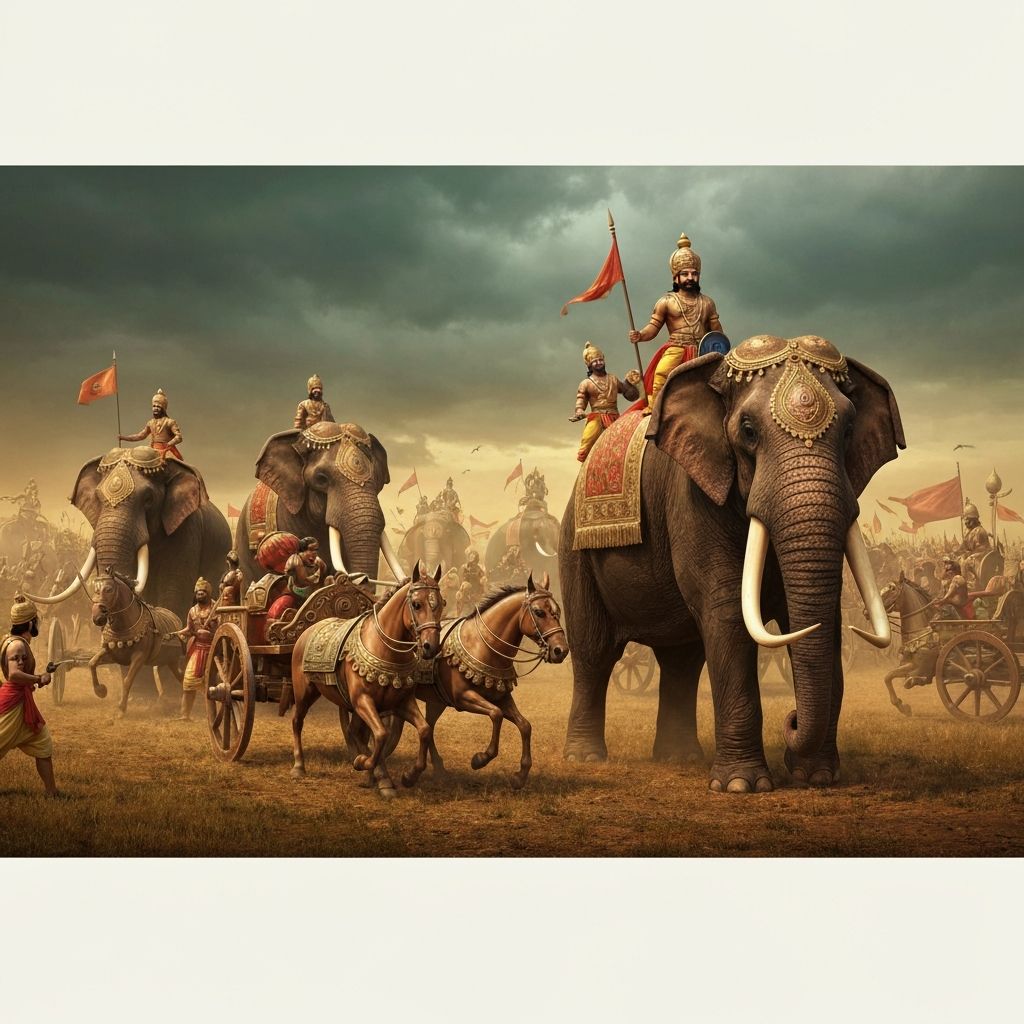
The Mahabharata
The world's longest epic poem — a vast narrative of war, wisdom, and the eternal struggle between dharma and adharma.
Composed
c. 400 BCE – 400 CE
Length
100,000 Shlokas
Read Time
10 min read
"What is found here may be found elsewhere. What is not found here will not be found elsewhere." This ancient claim about the Mahabharata captures its extraordinary scope. With over 100,000 shlokas (verses), it is roughly ten times the length of the Iliad and Odyssey combined — the longest poem ever composed in any language.
More Than a War Story
While the Mahabharata narrates the great war between the Pandavas and Kauravas for the throne of Hastinapura, it is far more than a tale of battle. Woven into its vast narrative are discourses on dharma (duty), artha (wealth), kama (desire), and moksha (liberation). It contains the Bhagavad Gita, the Vishnu Sahasranama, and countless stories-within-stories that explore every dimension of human experience.
The sage Vyasa is traditionally credited as its author, though the text as we have it today evolved over centuries, with multiple layers of composition. The epic itself acknowledges this, saying that Vyasa first taught it to his student Vaishampayana, who recited it at King Janamejaya's snake sacrifice.
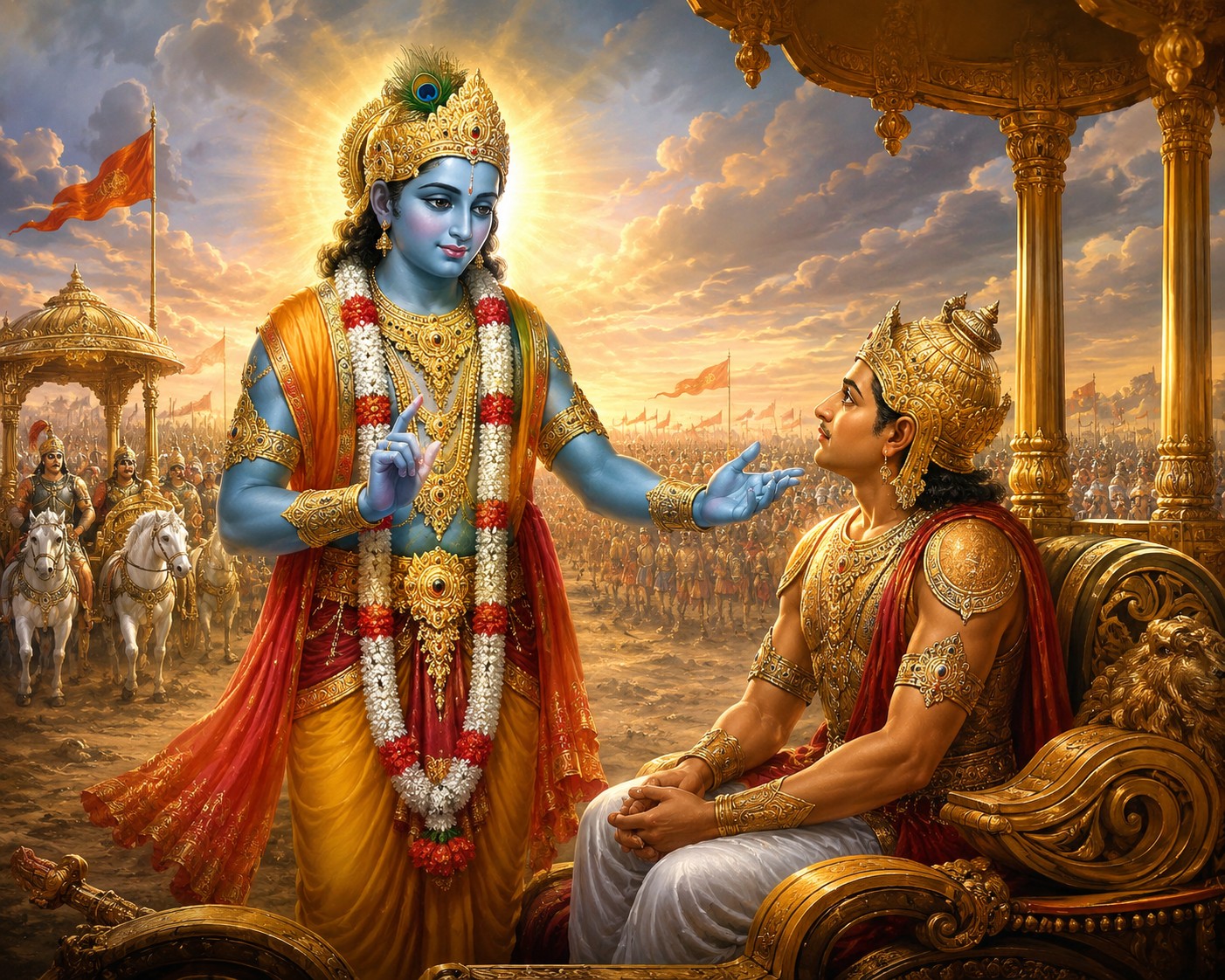
Krishna reveals the Bhagavad Gita to Arjuna between the two armies at Kurukshetra
The Eighteen Parvas
The Mahabharata is divided into eighteen parvas (books), each covering a distinct phase of the narrative. Here are some of the most significant:
Adi Parva
The Book of Beginnings · 227 chapters
The origins of the Kuru dynasty, the birth of the Pandavas and Kauravas, Draupadi's swayamvara, and the building of Indraprastha. It introduces the central characters and sets the stage for the great conflict.
Notable: Contains the story of Shakuntala and King Dushyanta, one of India's most beloved romantic tales.
Sabha Parva
The Book of the Assembly Hall · 81 chapters
The construction of the magnificent assembly hall at Indraprastha, the Rajasuya sacrifice, and the fateful game of dice where Yudhishthira loses everything — including Draupadi — to Shakuni's trickery.
Notable: Draupadi's humiliation in the Kaurava court and her vow of vengeance sets the war in motion.
Vana Parva
The Book of the Forest · 315 chapters
The thirteen years of exile, including the famous story of Nala and Damayanti, Arjuna's penance for divine weapons, and countless teachings on dharma delivered to Yudhishthira.
Notable: Contains the Yaksha Prashna — profound philosophical questions posed by a celestial being to Yudhishthira.
Bhishma Parva
The Book of Bhishma · 124 chapters
The first ten days of the Kurukshetra war under Bhishma's command. This parva contains the Bhagavad Gita — Krishna's immortal discourse to Arjuna on the battlefield.
Notable: The Bhagavad Gita's 700 verses have shaped Indian philosophy, spirituality, and culture for millennia.
Shanti Parva
The Book of Peace · 365 chapters
After the war, Bhishma lies on a bed of arrows, delivering extensive teachings on dharma, governance, and philosophy to Yudhishthira. The longest parva, it is a treatise on statecraft and ethics.
Notable: Contains the Vishnu Sahasranama — the thousand names of Vishnu — still chanted daily by millions.
Svargarohana Parva
The Book of the Ascent to Heaven · 6 chapters
The final journey of the Pandavas to Mount Meru, their deaths along the way, and Yudhishthira's ultimate test before entering heaven. A profound meditation on dharma and attachment.
Notable: Yudhishthira's refusal to enter heaven without his faithful dog reveals the essence of true dharma.
Key Characters
Krishna
Divine Guide
The avatar of Vishnu who serves as Arjuna's charioteer and delivers the Bhagavad Gita
Yudhishthira
Dharmaraja
The eldest Pandava, embodiment of righteousness, whose adherence to truth is tested repeatedly
Arjuna
The Peerless Archer
The greatest warrior of his age, to whom Krishna reveals divine wisdom on the battlefield
Bhishma
The Grandsire
The patriarch who took a vow of celibacy and lay dying on a bed of arrows for 58 days
Draupadi
The Fire-Born Queen
Wife of the five Pandavas, whose humiliation sparked the flames of war
Karna
The Tragic Hero
The noble warrior bound by loyalty to Duryodhana despite knowing his true Pandava heritage
"Dharma exists for the welfare of all beings. Hence, that by which the welfare of all living beings is sustained, that is dharma."
The Living Epic
The Mahabharata is not merely a text to be read — it is a living tradition that permeates Indian culture. Its stories are enacted in village performances, depicted in temple sculptures, and retold in countless regional versions across Southeast Asia. The Javanese Kakawin Bharatayuddha, the Thai Ramakien references, and the Balinese shadow puppet traditions all draw from this inexhaustible source.
In modern India, the 1988 television adaptation by B.R. Chopra brought the epic into every household, while contemporary writers like Devdutt Pattanaik and Amish Tripathi continue to reinterpret its stories for new generations. The questions it poses — about duty and desire, loyalty and betrayal, the nature of righteous action in an imperfect world — remain as relevant today as they were three thousand years ago.
The Mahabharata's Influence
- The Bhagavad Gita, embedded within the epic, has been translated into every major world language
- Concepts of dharma-yuddha (righteous war) and the just war theory find their roots here
- The epic inspired countless works of art, from Mughal miniatures to modern graphic novels
- Its narrative techniques influenced storytelling traditions across Asia
- Contemporary thinkers from Gandhi to Oppenheimer have drawn on its wisdom
The Mahabharata remains India's greatest gift to world literature — an epic that contains within it the full complexity of human existence, from the heights of spiritual wisdom to the depths of human frailty. To engage with it is to engage with questions that have occupied humanity since the beginning of civilisation.