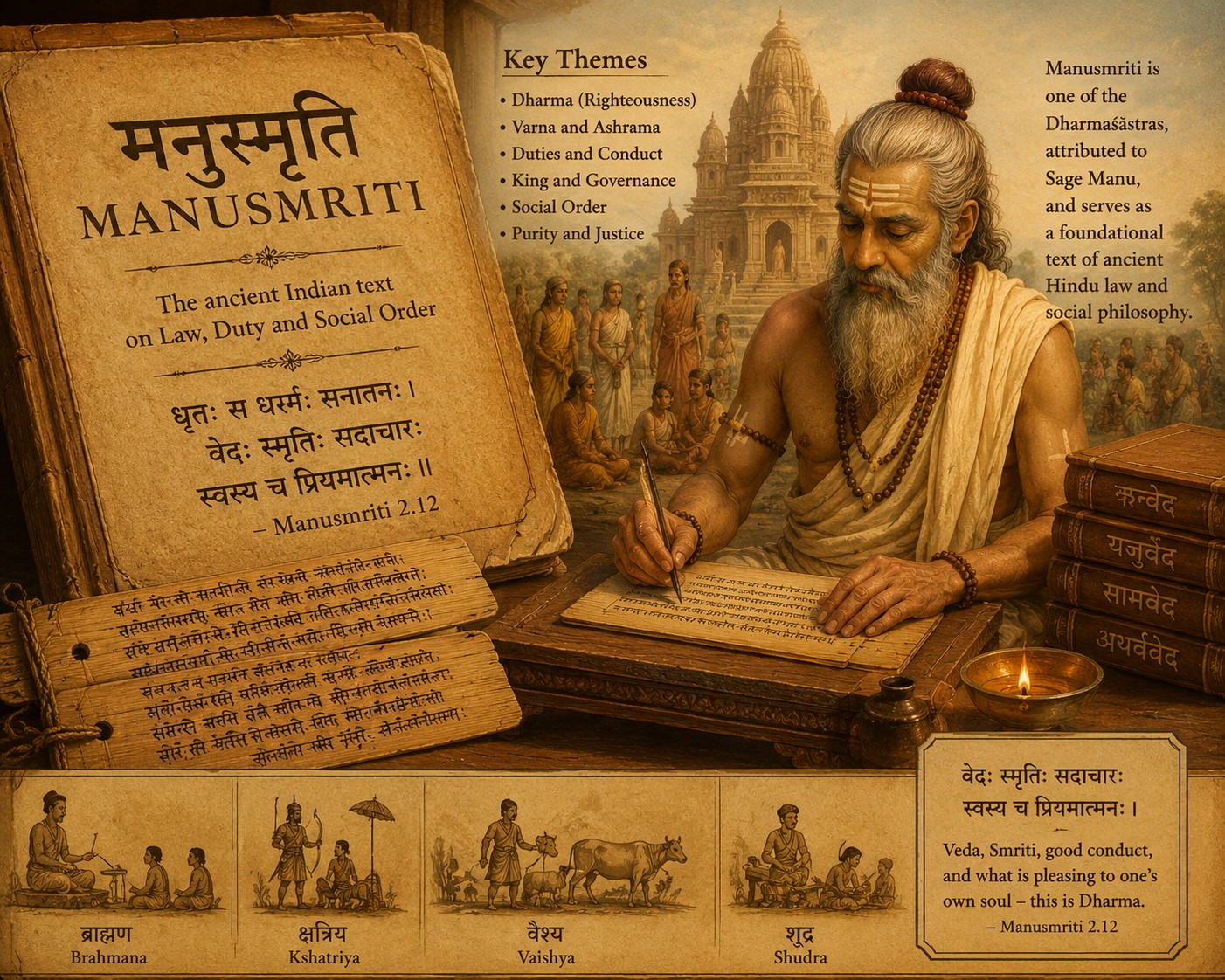
Manusmriti
The Laws of Manu — an ancient compendium on dharma, social ethics, and the duties of individuals and rulers that shaped Indian civilisation for millennia.
Composed
c. 200 BCE – 200 CE
Structure
12 Chapters, 2,685 Verses
Read Time
10 min read
Few texts in Indian history have been as influential — or as controversial — as the Manusmriti. Attributed to Manu, the mythological progenitor of humanity, this dharmashastra (treatise on dharma) served as a foundational legal and ethical code for much of traditional Indian society. Its verses shaped laws, rituals, and social norms across the subcontinent for nearly two thousand years.
What is the Manusmriti?
The Manusmriti, also known as Manava-Dharmashastra (The Dharma Text of Manu), is a metrical Sanskrit text belonging to the genre of Dharmashastra — literature prescribing codes of conduct, legal procedures, and ethical principles. Unlike the Vedas (Shruti), it is classified as Smriti — "that which is remembered" — indicating human authorship based on Vedic principles.
The text is framed as a discourse delivered by Manu — the first man and lawgiver — to a group of sages who ask him to explain the dharma of all the social classes. Manu in turn attributes the teaching to Brahma, the creator, lending the text divine authority while maintaining its human transmission.
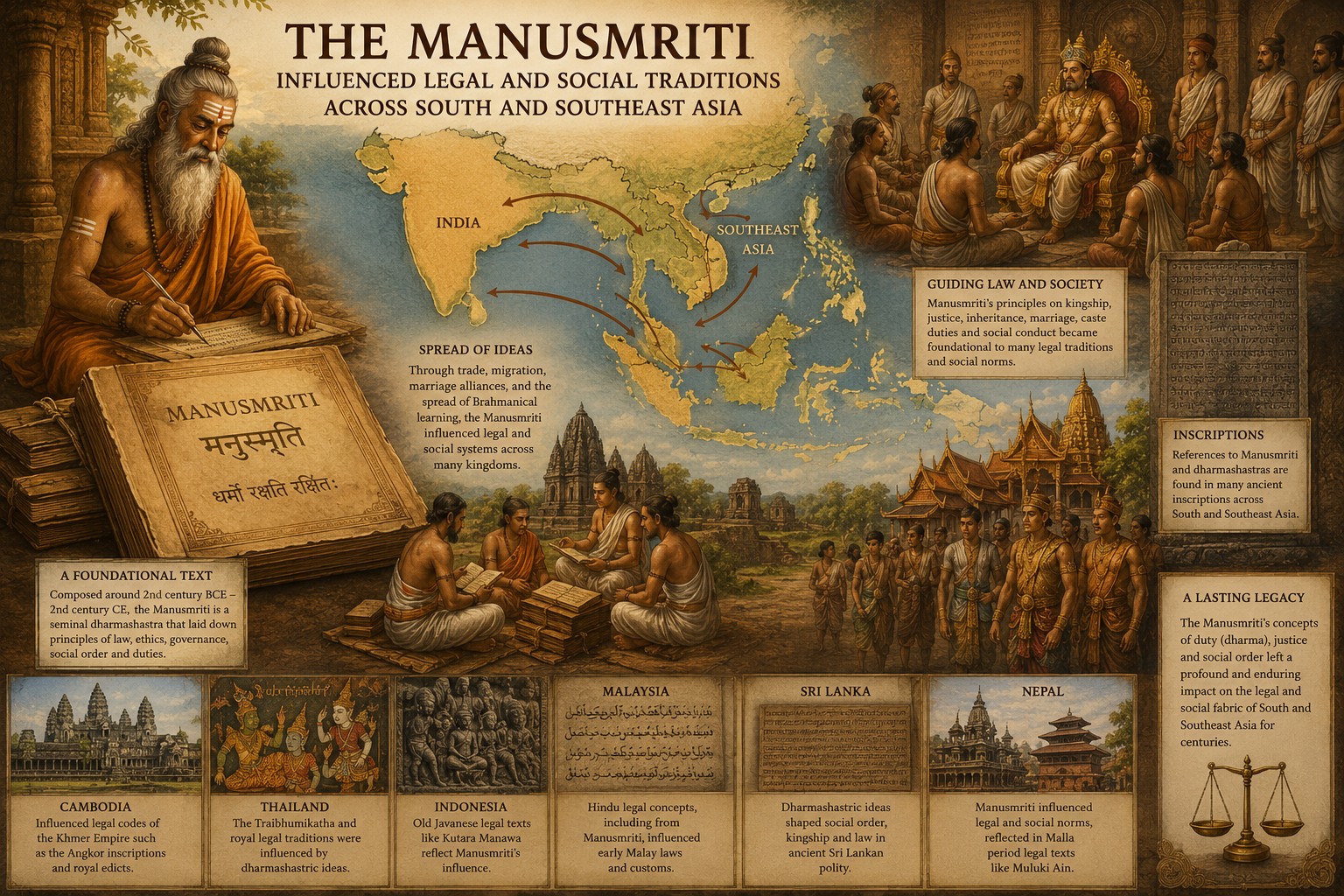
The Manusmriti influenced legal and social traditions across South and Southeast Asia
Structure and Content
The Manusmriti is organised into twelve chapters (adhyayas) containing 2,685 verses (shlokas). It covers an extraordinary range of topics — from cosmic creation to daily hygiene, from kingship to kitchen duties.
Creation & Social Order
Chapters 1-2 · ~400 verses
The Manusmriti opens with the cosmogony — Brahma's creation of the universe and the emergence of Manu, the progenitor of humanity. It then establishes the fourfold varna system (Brahmana, Kshatriya, Vaishya, Shudra) and the four ashramas (student, householder, forest-dweller, renunciate) as the ideal framework for human society and spiritual progress.
Notable: The text frames varna as based on qualities and occupation, though later interpretation often conflated it with hereditary caste.
The Dharma of the Householder
Chapters 3-5 · ~600 verses
The longest portion deals with the grihastha (householder) stage — marriage, duties of husband and wife, hospitality, daily rituals, dietary regulations, and the concept of purity. It emphasises the householder as the foundation of society, supporting students, renouncers, and the departed through rituals.
Notable: Contains the famous verse: 'Where women are honoured, there the gods are pleased; where they are not honoured, no sacred rite yields rewards.' (3.56)
The Dharma of Kings
Chapters 7-9 · ~800 verses
Rajadharma — the duties of rulers — forms a substantial section. It covers the appointment of ministers, foreign policy (the mandala theory of states), taxation, warfare, justice, punishment, and the protection of subjects. Manu presents the king as the upholder of cosmic and social order.
Notable: Manu's theory of danda (punishment) influenced later political philosophy, including Kautilya's Arthashastra.
Law, Penance & Liberation
Chapters 10-12 · ~500 verses
The concluding chapters address mixed castes, occupations in times of distress, prayaschitta (atonement for transgressions), and the doctrine of karma. The final chapter soars into metaphysics — the nature of the self, the fruits of action, and the path to moksha through knowledge and detachment.
Notable: The text ends by declaring that one who knows the self transcends all dharma and adharma, attaining the supreme state.
Key Concepts
The Manusmriti introduces and elaborates several concepts that became central to Indian thought:
- Varnashrama Dharma — duties based on one's social class (varna) and stage of life (ashrama)
- Sadachara — virtuous conduct derived from the behaviour of learned people
- Prayaschitta — atonement and expiation for transgressions against dharma
- Danda — punishment as the upholder of social order
- Stri-dharma — duties and rights of women, including property and marriage
- Rajadharma — the sacred duties of kings to protect and maintain justice
"Dharma protects those who protect it. Dharma destroyed, destroys. Therefore, dharma should not be violated, lest violated dharma destroy us."
Historical Influence
The Manusmriti exercised enormous influence across South and Southeast Asia. It shaped the legal codes of Hindu kingdoms from Kashmir to Java, from Nepal to Cambodia. Its commentaries — by scholars like Medhatithi, Kulluka, and Govindaraja — became standard reference texts for centuries.
British colonial administrators used the Manusmriti (along with other texts) as a basis for "Hindu law" in their courts — a practice that ironically gave the text more legal authority than it had possessed in the flexible, pluralistic legal landscape of pre-colonial India. This colonial codification also fossilised interpretations that had previously been debated and evolved.
The Modern Debate
Today, the Manusmriti is both studied and criticised. Some verses regarding women and lower castes have been condemned as discriminatory, while other passages praising women and emphasising righteous conduct are often overlooked. Scholars debate whether the text represents prescriptive law or idealised social theory, and how much of it was actually followed in practice.
Dr. B.R. Ambedkar famously burned copies of the Manusmriti in 1927 as a protest against caste discrimination. Yet the text remains an important primary source for understanding ancient Indian legal thought, social organisation, and the evolution of Hindu dharma.
Reading the Manusmriti Today
Any modern engagement with the Manusmriti requires historical sensitivity. The text was composed in a specific social context and reflects the assumptions of its time. Its verses on varna, gender, and purity cannot be uncritically applied to contemporary life.
Yet the Manusmriti also contains insights into ethics, governance, and self-discipline that transcend its era. Its vision of dharma as the sustaining principle of cosmos and society, its emphasis on self-control and righteous action, and its metaphysical conclusion pointing beyond all rules to the liberation of the self — these elements continue to reward careful study.