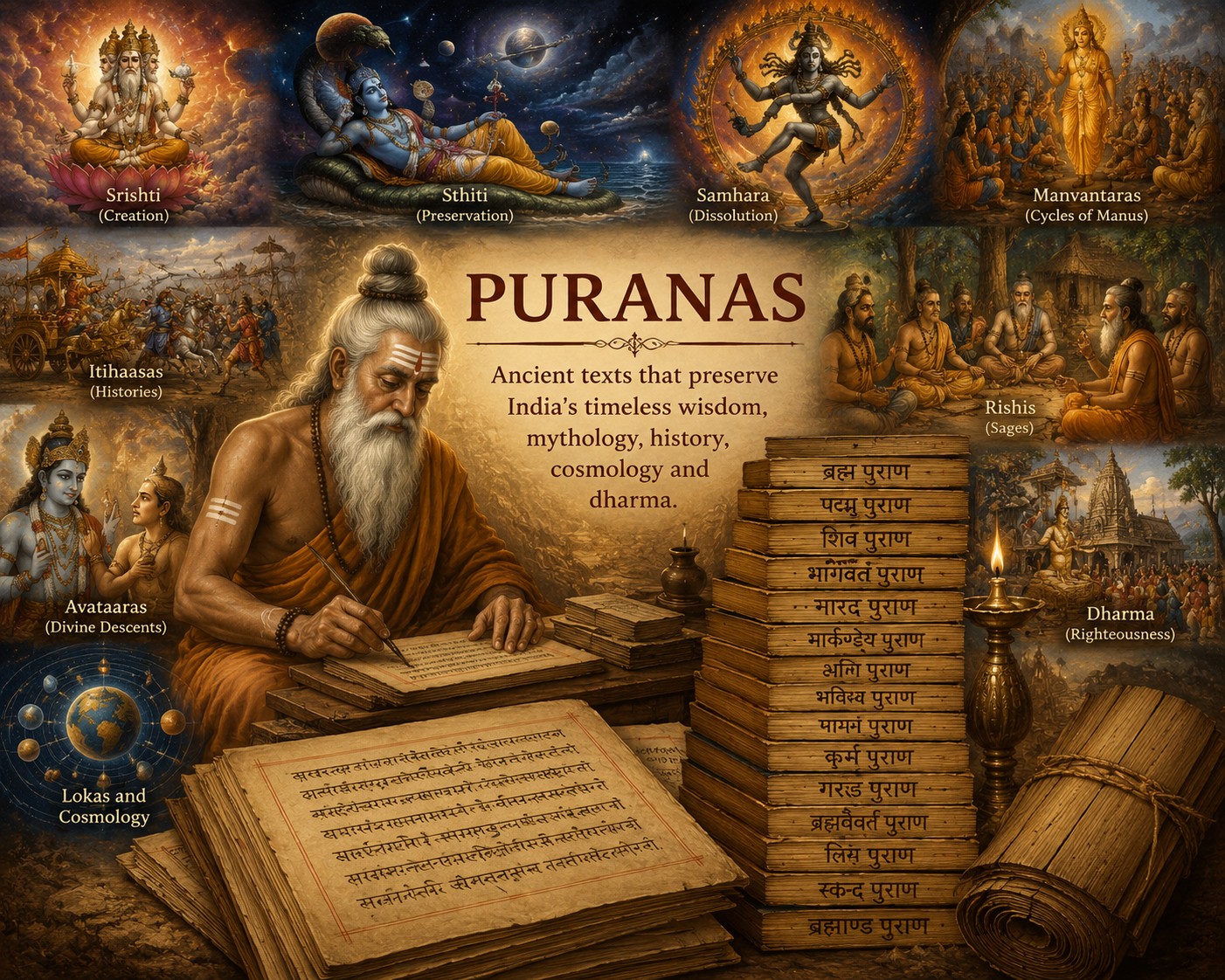
The Puranas
Encyclopaedias of myth, legend, and devotion — the texts that brought the abstract wisdom of the Vedas to the hearts of common people.
Composed
c. 300–1500 CE
Total
18 Mahapuranas
Read Time
8 min read
The word "Purana" means "old" or "ancient," and these texts preserve the collective memory of Hindu civilisation — its myths, legends, cosmology, philosophy, and devotional practices. While the Vedas were restricted to Brahmin priests, the Puranas opened the doors of spiritual wisdom to everyone, regardless of caste or gender.
The Fifth Veda
The Puranas are sometimes called the "Fifth Veda" — the Veda for the Kali Yuga, the current age of spiritual decline. Where the original Vedas require years of training and initiation, the Puranas communicate the same truths through stories, accessible to anyone who listens. They transformed abstract Vedantic philosophy into living religion.
Traditionally, the sage Vyasa — who also compiled the Vedas and composed the Mahabharata — is credited with authoring all eighteen Mahapuranas. In practice, these texts evolved over centuries, with multiple authors contributing to each. They reflect the diversity of Hindu worship: six Puranas each for Vishnu, Shiva, and Brahma.
The Pancha Lakshana
According to tradition, every Purana should contain five characteristic topics (pancha lakshana):
Sarga
Primary creation of the universe from cosmic principles
Pratisarga
Secondary creation, dissolution, and re-creation cycles
Vamsha
Genealogies of gods, sages, and royal dynasties
Manvantara
Cosmic time periods and the reigns of the Manus
Vamshanucharita
Histories of the Solar and Lunar dynasties
The Eighteen Mahapuranas
The eighteen great Puranas are divided by the deity they primarily glorify. Here are some of the most significant:
Vishnu Purana
Primary Deity: Vishnu · 23,000 verses
One of the oldest and most important Puranas, focusing on Vishnu's avatars, cosmology, and the Vamshas (dynastic genealogies). It contains the beautiful story of Prahlada and Narasimha.
Notable: The source of the famous verse 'Dharmo rakshati rakshitah' — Dharma protects those who protect dharma.
Bhagavata Purana
Primary Deity: Krishna · 18,000 verses
The most beloved of all Puranas, centring on the life and teachings of Krishna. Its tenth skandha, describing Krishna's childhood and Vrindavan leelas, has inspired countless devotional movements.
Notable: The Bhagavata's Rasa Lila and its philosophy of divine love transformed Indian spirituality and arts.
Shiva Purana
Primary Deity: Shiva · 24,000 verses
Dedicated to Lord Shiva, containing his origin stories, the significance of the Shiva Linga, tales of his consort Parvati, and the glory of pilgrimage sites sacred to Shiva.
Notable: Details the twelve Jyotirlingas — the most sacred Shiva temples in India.
Devi Bhagavata Purana
Primary Deity: Devi · 18,000 verses
The supreme text of Shaktism, glorifying the Divine Mother as the ultimate reality. Contains the Devi Gita — the Goddess's own discourse parallel to the Bhagavad Gita.
Notable: Source of the Devi Mahatmya, recited during Navaratri and the most important Shakta scripture.
Markandeya Purana
Primary Deity: Various · 9,000 verses
Contains the famous Devi Mahatmya (Durga Saptashati) — 700 verses celebrating the Goddess's victory over demons. One of the oldest Puranas with philosophical depth.
Notable: The Devi Mahatmya is recited by millions during Navaratri and is central to Goddess worship.
Garuda Purana
Primary Deity: Vishnu · 19,000 verses
A dialogue between Vishnu and Garuda covering cosmology, dharma, and notably detailed descriptions of death, afterlife, funeral rites, and the journey of the soul.
Notable: Traditionally recited during the mourning period after death in Hindu households.
"The Purana is so called because it completes; the Purana is so called because it is ancient. One who knows this etymology truly knows the Purana."
Living Tradition
The Puranas are not museum pieces — they remain central to Hindu religious practice. Temple priests draw on them for worship procedures. Families recite them during festivals and rites of passage. The Bhagavata Saptaha — a week-long recitation of the Bhagavata Purana — is regularly performed across India. During Navaratri, millions recite the Devi Mahatmya from the Markandeya Purana.
Beyond the eighteen Mahapuranas, there are also eighteen Upapuranas (minor Puranas) and numerous Sthala Puranas (local Puranas) that tell the mythological histories of specific temples and pilgrimage sites. This vast literature continues to be composed and expanded even today.
The Puranic Legacy
- Temple architecture and iconography are based on Puranic descriptions of the gods
- Hindu festivals — from Diwali to Holi — derive their stories from Puranic narratives
- Classical Indian dance and drama draw their themes from Puranic mythology
- Pilgrimage traditions and sacred geography are mapped in the Puranas
- The bhakti movements of medieval India were inspired by Puranic devotion
The Puranas democratised Hindu spirituality. Through their stories of gods and demons, sages and kings, they made cosmic truths accessible to everyone — the farmer in the field, the mother at home, the child listening at the temple. They are India's great gift to popular religion.