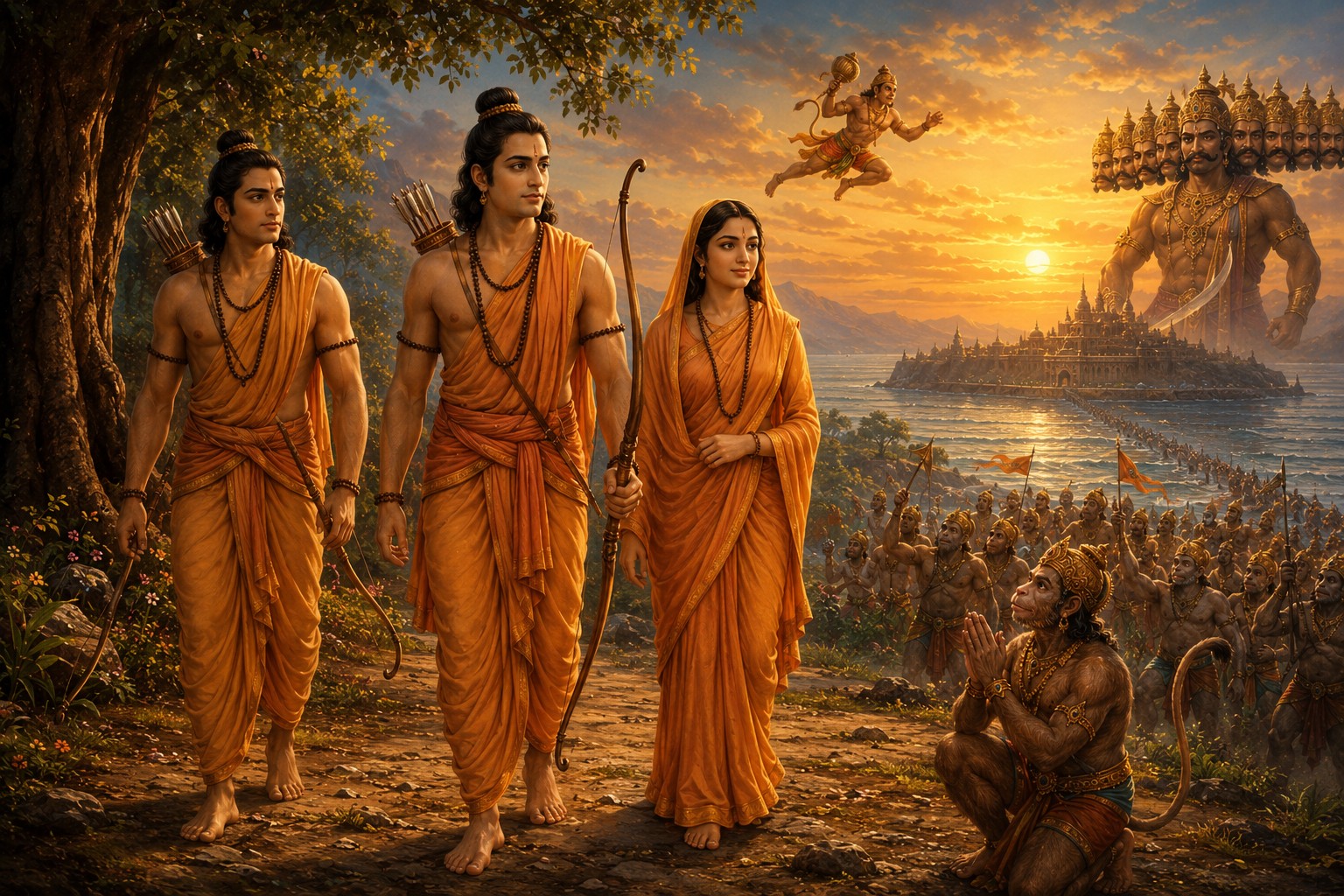
The Ramayana
Valmiki's immortal epic — the journey of Rama, the ideal man, and the eternal triumph of dharma over adharma.
Composed
c. 500–100 BCE
Length
24,000 Shlokas
Read Time
9 min read
The Ramayana is called the Adi Kavya — the first poem. Its author, Valmiki, is honoured as Adi Kavi, the first poet. Legend holds that when Valmiki witnessed a hunter kill one of a pair of mating cranes, his grief spontaneously emerged as verse — the first shloka ever composed. From that moment of compassion, the entire epic was born.
The Ideal and the Real
Where the Mahabharata explores the complexities and moral ambiguities of human existence, the Ramayana offers ideals to aspire towards. Rama is Maryada Purushottama — the supreme person who establishes the boundaries of righteous conduct. Sita embodies purity and unwavering devotion. Hanuman represents selfless service and bhakti. Lakshmana exemplifies brotherly loyalty.
Yet the Ramayana is not a simple morality tale. Its characters face impossible choices — Rama must choose between his duty as a king and his love for Sita; Bharata must navigate the guilt of his mother's actions; Vibhishana must weigh blood loyalty against dharma. These tensions give the epic its enduring power.
The Seven Kandas
The Ramayana is divided into seven kandas (books), though the first and last are sometimes considered later additions. The core narrative spans the middle five:
Bala Kanda
Book of Youth · 2,364 shlokas
The birth of Rama and his brothers, their childhood in Ayodhya, Vishwamitra's request for protection, the slaying of Tataka, and Rama's marriage to Sita after breaking Shiva's bow at Janaka's court.
Notable: Rama's effortless breaking of Shiva's celestial bow, which no king could even lift, establishes his divine nature.
Ayodhya Kanda
Book of Ayodhya · 4,294 shlokas
The preparations for Rama's coronation, Kaikeyi's demand for Bharata's kingship and Rama's exile, the heartbreaking departure, King Dasharatha's death from grief, and Bharata's refusal to accept the throne.
Notable: Bharata places Rama's sandals on the throne, ruling as a regent for fourteen years — a supreme act of devotion and dharma.
Aranya Kanda
Book of the Forest · 2,647 shlokas
Life in the forest, encounters with sages and demons, the mutilation of Shurpanakha, and the abduction of Sita by Ravana through Maricha's golden deer deception. Jatayu's heroic sacrifice.
Notable: The dying Jatayu, having fought Ravana to save Sita, achieves liberation from Rama himself.
Kishkindha Kanda
Book of Kishkindha · 2,305 shlokas
Rama's alliance with Sugriva, the vanara king, after helping him defeat Vali. The search for Sita begins, and Hanuman emerges as the chosen messenger.
Notable: The relationship between Rama and Hanuman becomes the archetypal model of bhakti (devotion).
Sundara Kanda
Book of Beauty · 2,916 shlokas
Hanuman's leap across the ocean, his search through Lanka, his discovery of Sita in the Ashoka grove, and the burning of Lanka. The most celebrated and auspicious section of the epic.
Notable: Recitation of Sundara Kanda is considered highly auspicious and is performed during times of difficulty.
Yuddha Kanda
Book of War · 5,692 shlokas
The building of the bridge to Lanka, the great war between Rama's vanara army and Ravana's forces, the deaths of Kumbhakarna and Indrajit, and the final battle where Rama slays Ravana.
Notable: Vibhishana's dharmic choice to abandon his brother Ravana and join Rama exemplifies righteousness over blood loyalty.
Key Characters
Rama
Maryada Purushottama
The ideal man and avatar of Vishnu — embodiment of dharma, duty, and righteous conduct
Sita
The Earth's Daughter
Rama's devoted wife, the ideal of purity, courage, and wifely virtue
Hanuman
The Devotee Supreme
The vanara warrior whose devotion to Rama transcends all obstacles
Lakshmana
The Loyal Brother
Rama's inseparable brother who shares every moment of his exile and suffering
Ravana
The Learned Demon King
The ten-headed ruler of Lanka — a great scholar and devotee, yet consumed by desire
Bharata
The Selfless Brother
Who ruled Ayodhya in Rama's name, never sitting on the throne himself
"As long as mountains stand and rivers flow upon the earth, so long will the story of Rama be told among men."
A Pan-Asian Epic
The Ramayana's influence extends far beyond India. In Thailand, the Ramakien is a national epic performed in classical dance. Cambodia's Reamker adorns the walls of Angkor Wat. Indonesia's Kakawin Ramayana shapes Javanese and Balinese performing arts. Myanmar, Laos, Malaysia, and the Philippines all have their own Ramayana traditions.
Within India, multiple versions exist: Kamban's Tamil Ramavataram, Tulsidas's Hindi Ramcharitmanas (the most widely read version in North India), Krittibas's Bengali rendition, and Eknath's Marathi Bhavartha Ramayana. Each retelling emphasises different aspects — the devotional, the philosophical, the narrative.
The Ramayana in Indian Life
- Diwali, India's festival of lights, celebrates Rama's return to Ayodhya after fourteen years of exile
- Ram Navami marks Rama's birth and is observed across the country with fasting and worship
- Ramlila — dramatic folk re-enactments — are performed annually in thousands of villages
- The Ramcharitmanas is recited in homes and temples as an act of devotion and merit
- Hanuman Chalisa, composed by Tulsidas, is one of the most recited devotional texts in Hinduism
The Ramayana endures because it speaks to something eternal in the human heart — the longing for an ideal, the struggle to uphold dharma in a world of compromise, the transformative power of devotion. Rama's story is not just history or mythology; it is a living presence in the spiritual life of millions.