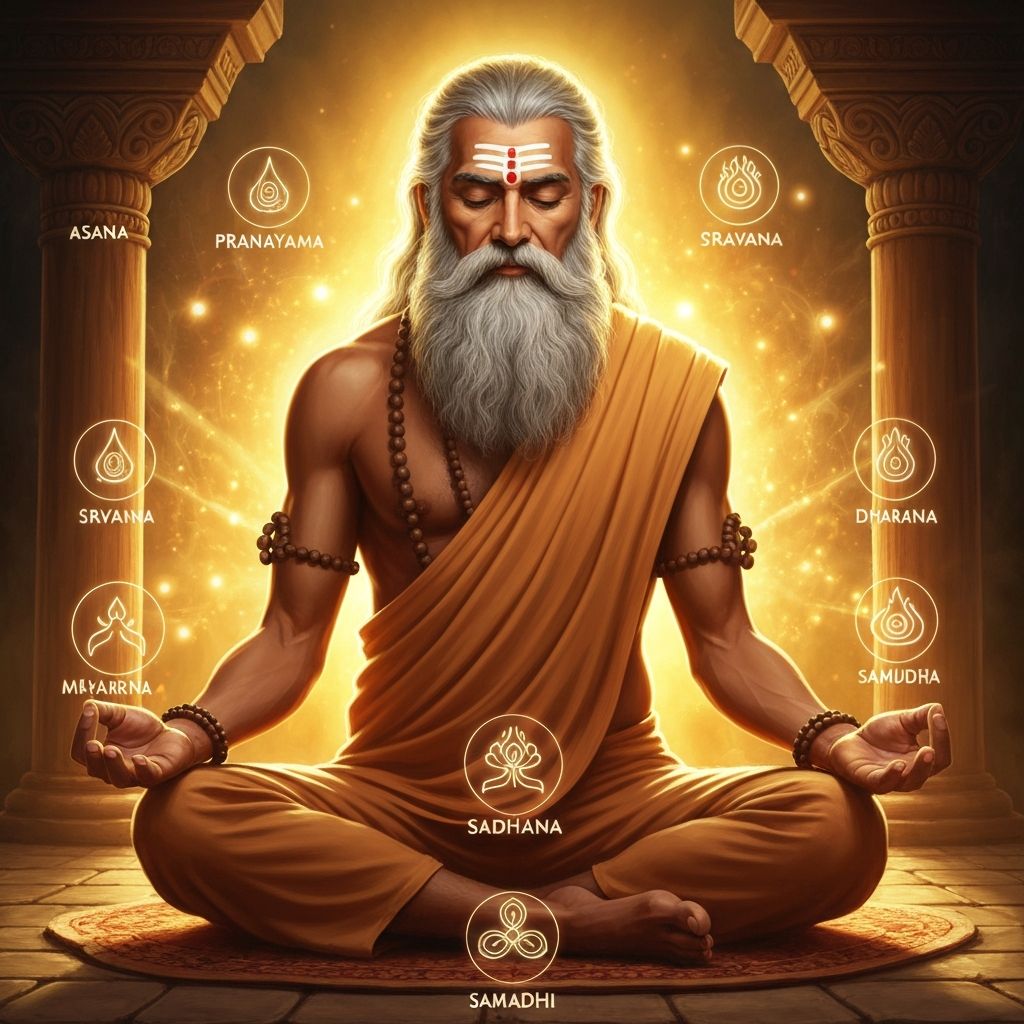
Yoga Sutras of Patanjali
The foundational text of classical yoga — 196 aphorisms mapping the path from mental turbulence to absolute liberation.
Composed
c. 400 CE
Structure
4 Chapters, 196 Sutras
Read Time
10 min read
In 196 terse aphorisms, the sage Patanjali distilled centuries of yogic knowledge into a systematic philosophy of mind and liberation. The Yoga Sutras do not teach physical postures — they map the architecture of consciousness and the path to freedom from suffering. Every major yoga tradition in the world traces its philosophical lineage to this remarkable text.
Who Was Patanjali?
Patanjali remains a mysterious figure. Tradition holds that he also authored the Mahabhashya (a great commentary on Sanskrit grammar) and a text on Ayurveda — suggesting a polymath who systematised three fundamental Indian sciences. Some scholars identify him with a grammarian of the 2nd century BCE; others date the Yoga Sutras to around 400 CE based on textual analysis.
Legend describes Patanjali as an incarnation of Ananta (the cosmic serpent), who fell from heaven into the cupped hands of a woman named Gonika as she offered water to the sun — hence the name Patanjali ("fallen into folded hands"). Whatever his historical identity, his text became the canonical foundation of yoga philosophy.

The Yoga Sutras present a systematic path from mental agitation to complete stillness and liberation
The Four Chapters (Padas)
The Yoga Sutras are divided into four chapters, each addressing a different aspect of the yogic path.
Samadhi Pada
On Contemplation · 51 sutras
The first chapter defines yoga as 'chitta vritti nirodha' — the cessation of the fluctuations of the mind. It describes the nature of the mind, the obstacles to stillness, and the various levels of samadhi (absorption). This pada is addressed to advanced practitioners already capable of some degree of concentration.
Notable: Sutra 1.2 — 'Yogash chitta vritti nirodhah' (Yoga is the restraint of the modifications of the mind) — is considered the definitive statement of yoga's purpose.
Sadhana Pada
On Practice · 55 sutras
The second chapter introduces Kriya Yoga (the yoga of action) and outlines the kleshas (afflictions) that cause suffering — ignorance, ego, attachment, aversion, and fear of death. It presents the first five limbs of Ashtanga Yoga: yama (restraints), niyama (observances), asana (posture), pranayama (breath control), and pratyahara (sense withdrawal).
Notable: The five kleshas described here became foundational to Buddhist psychology as well, showing the shared philosophical heritage.
Vibhuti Pada
On Accomplishments · 56 sutras
The third chapter describes the final three internal limbs — dharana (concentration), dhyana (meditation), and samadhi (absorption) — together called samyama. It then catalogues the siddhis (supernatural powers) that arise from samyama on various objects, while warning that these powers can become obstacles to liberation.
Notable: Patanjali lists powers like knowledge of past lives, reading others' minds, and invisibility — but emphasises these are distractions from the true goal.
Kaivalya Pada
On Liberation · 34 sutras
The final chapter explores the nature of liberation (kaivalya) — the absolute independence of purusha (consciousness) from prakriti (matter). It discusses the mechanics of karma, the nature of time, and culminates in the description of the liberated state where consciousness rests in its own nature, free from all mental modifications.
Notable: The text ends with purusha established in its own nature — 'svarupa pratishtha' — the ultimate goal of all yogic practice.
Ashtanga: The Eight Limbs
The most famous teaching of the Yoga Sutras is Ashtanga — the eight-limbed path. These are not sequential steps but interwoven practices that support and deepen each other.
Yama — Restraints
Non-violence (ahimsa), truthfulness (satya), non-stealing (asteya), continence (brahmacharya), non-possessiveness (aparigraha)
Niyama — Observances
Purity (saucha), contentment (santosha), austerity (tapas), self-study (svadhyaya), surrender to the divine (Ishvara pranidhana)
Asana — Posture
Steady and comfortable seated position for meditation — later expanded in Hatha Yoga traditions
Pranayama — Breath Control
Regulation of inhalation, exhalation, and retention to refine the vital energy (prana)
Pratyahara — Sense Withdrawal
Drawing the senses inward, away from external objects, like a tortoise withdrawing its limbs
Dharana — Concentration
Fixing the mind on a single point — an object, mantra, or concept
Dhyana — Meditation
Unbroken flow of awareness toward the object of concentration
Samadhi — Absorption
Complete absorption where the meditator, meditation, and object become one
"Yoga is the restraint of the modifications of the mind. Then the seer abides in its own nature."
The Psychology of the Sutras
Patanjali presents a sophisticated psychology. The mind (chitta) is composed of manas (the thinking faculty), buddhi (intellect/discrimination), and ahamkara (ego/I-sense). It undergoes constant modifications (vrittis) — valid cognition, error, imagination, sleep, and memory.
These modifications, conditioned by past impressions (samskaras) and afflictions (kleshas), keep consciousness bound to identification with mental content. Yoga practice gradually reduces these modifications until consciousness can rest in its own nature — pure awareness, distinct from all mental phenomena.
Key Concepts
- Purusha — Pure consciousness, the witness, eternally free
- Prakriti — Nature, matter, the field of experience
- Chitta — The mind-stuff that undergoes modification
- Vritti — Mental fluctuations or modifications
- Klesha — Afflictions: ignorance, ego, attachment, aversion, fear of death
- Samskara — Impressions or traces left by past actions
- Kaivalya — Liberation, the absolute independence of consciousness
Influence and Legacy
The Yoga Sutras became the foundational text of the Yoga darshana — one of the six classical schools of Indian philosophy. Its commentary tradition is vast, with the Yoga Bhashya of Vyasa (5th century) being the oldest and most authoritative. Later commentators include Vachaspati Mishra, Vijnanabhikshu, and in modern times, Swami Vivekananda, T.K.V. Desikachar, and B.K.S. Iyengar.
Today, the text forms the philosophical backbone of yoga teacher training programmes worldwide. While modern yoga often emphasises asana (physical postures), the Yoga Sutras remind us that posture is just one limb of a comprehensive system aimed at nothing less than the liberation of consciousness itself.