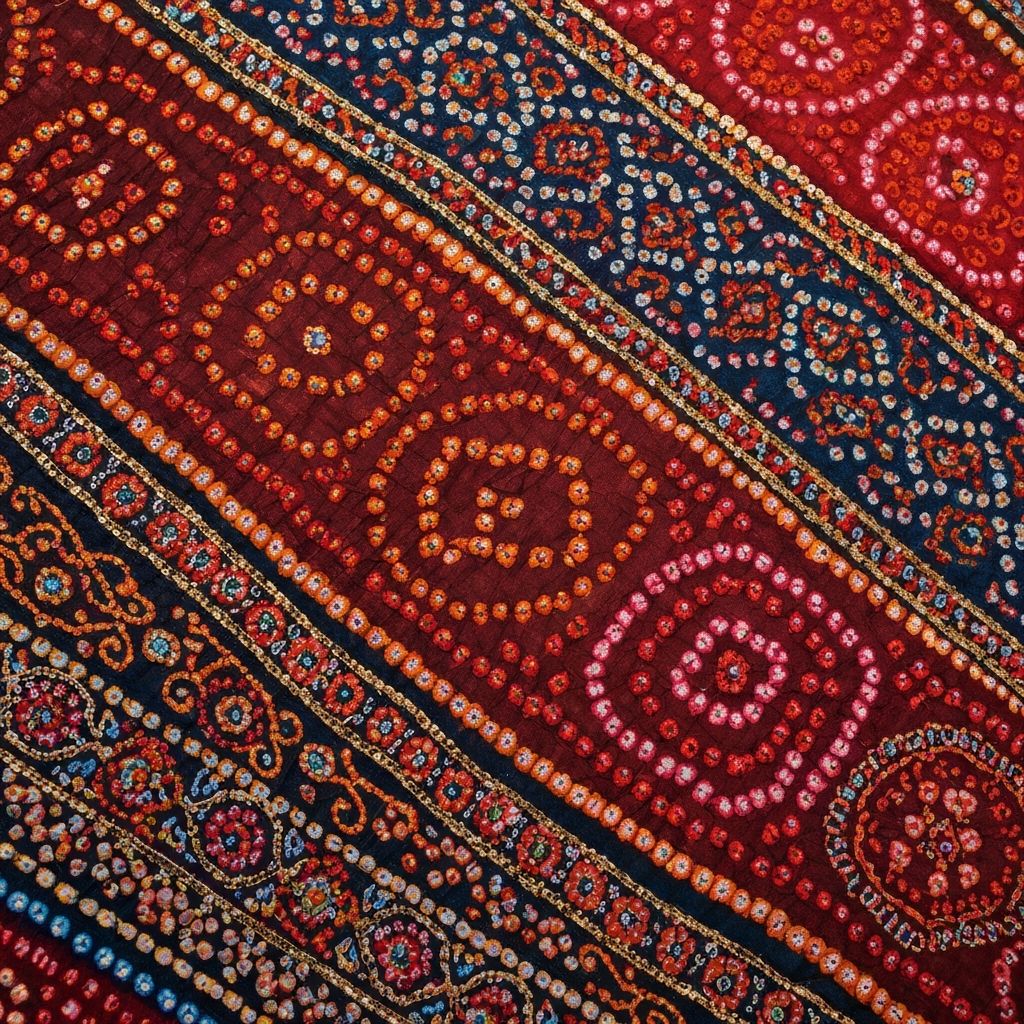
Bandhani
A thousand tiny knots, a million dots of color - the tie-dye magic of Western India.
Origin
Gujarat & Rajasthan
History
5000+ Years
Technique
Resist Dyeing
Recognition
GI Tagged
Bandhani, from the Sanskrit "Bandh" meaning to tie, is one of the oldest tie-dye traditions in the world. Archaeological findings suggest this craft existed in the Indus Valley Civilization over 5000 years ago, making it one of humanity's earliest textile arts.
The technique involves tying tiny portions of fabric with thread before dyeing, creating patterns of undyed dots. A single saree can have hundreds of thousands of such knots, each tied by hand with incredible precision. The patterns emerge only when the knots are opened after dyeing.
Bandhani is deeply embedded in the culture of Gujarat and Rajasthan, associated with auspiciousness and celebration. A bride's trousseau is incomplete without Bandhani, and the traditional red Bandhani odhni (veil) is considered essential for married women during festivals.
Traditional Patterns
Shikari
Hunting scenes and forest motifs
Chandrokhani
Moon-shaped designs
Beldaar
Vine and creeper patterns
Dungar Shahi
Mountain peak designs
Jaaldar
Net-like intricate patterns
Chaubasi
Four-sided geometric design
The Bandhani Process
- Design transfer using wooden blocks or freehand
- Hand-tying of tiny fabric sections with thread
- Sequential dyeing from lighter to darker colors
- Opening knots to reveal the pattern
- Finishing and optional gold/silver printing