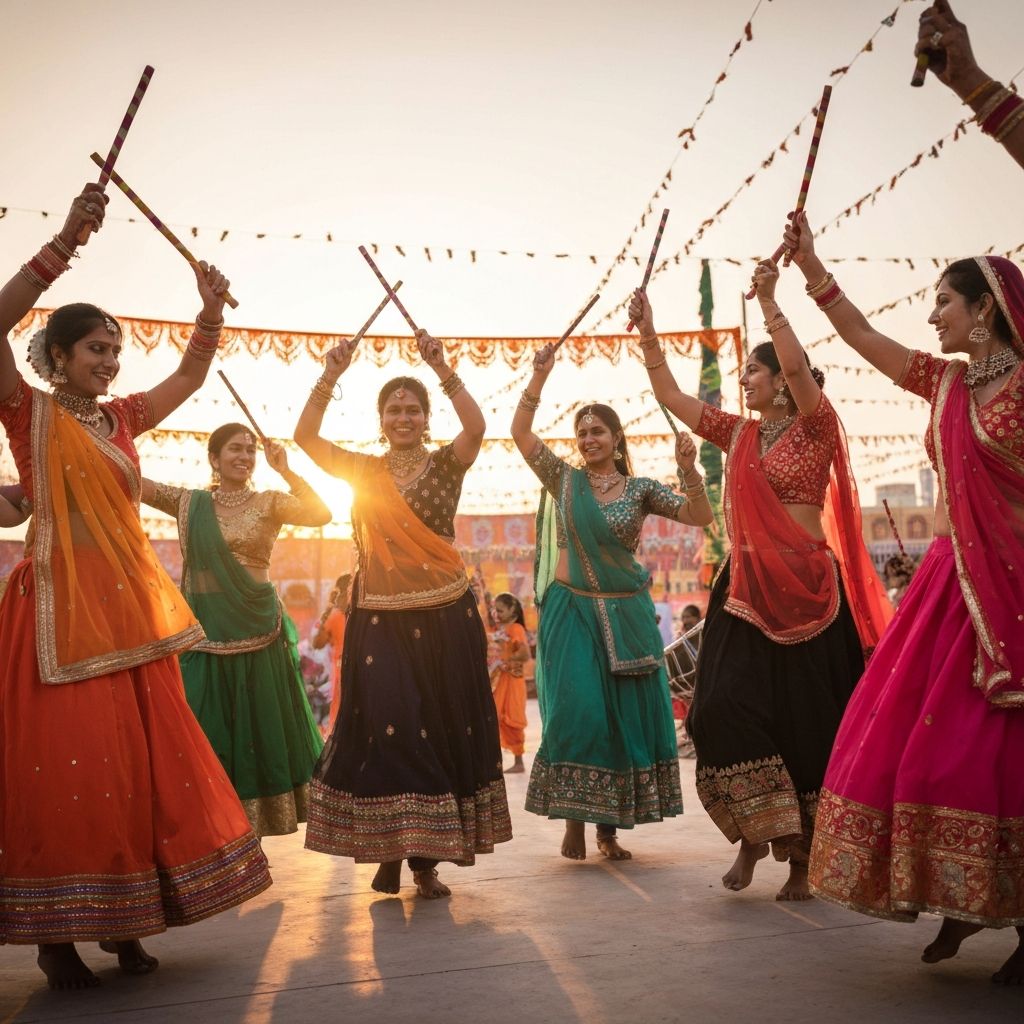
Garba
Gujarat's celebration of life - where circles of dancers honor the divine feminine.
Origin
Gujarat
Festival
Navratri (Nine Nights)
Music
Garba Songs & Dhol
Participation
Community Dance
Garba is the heart and soul of Gujarat's Navratri celebrations - nine nights dedicated to the worship of Goddess Durga. The word "Garba" comes from "Garbha" (womb) and "Deep" (lamp), referring to the earthen pot with holes containing a lamp around which the dance is traditionally performed.
The circular formation of the dance represents the cycle of time - from birth to death and rebirth - circling the divine feminine energy at the center. What begins as devotion transforms into an exuberant celebration as the nights progress, with the tempo and energy building throughout the festival.
Today, Garba has transcended its religious origins to become a cultural phenomenon celebrated worldwide. From the streets of Ahmedabad to community centers in New Jersey, millions participate in this joyous expression of Gujarati culture.
Garba Styles
Garba
Circular dance performed around a lamp or deity
Dandiya Raas
Partner dance using decorated wooden sticks
Tran Taali
Three-clap rhythm pattern dance
Hinch
Swaying motion dance with flowing movements
Popatiyu
Playful dance mimicking a parrot's movements
Dodhiyu
Fast-paced running dance
The Garba Costume
- Chaniya Choli: Embroidered flared skirt and blouse for women
- Dupatta: Colorful scarf draped elegantly
- Kediyu: Traditional top for men with churidar
- Mirror Work: Embellished with mirrors, beads, and embroidery