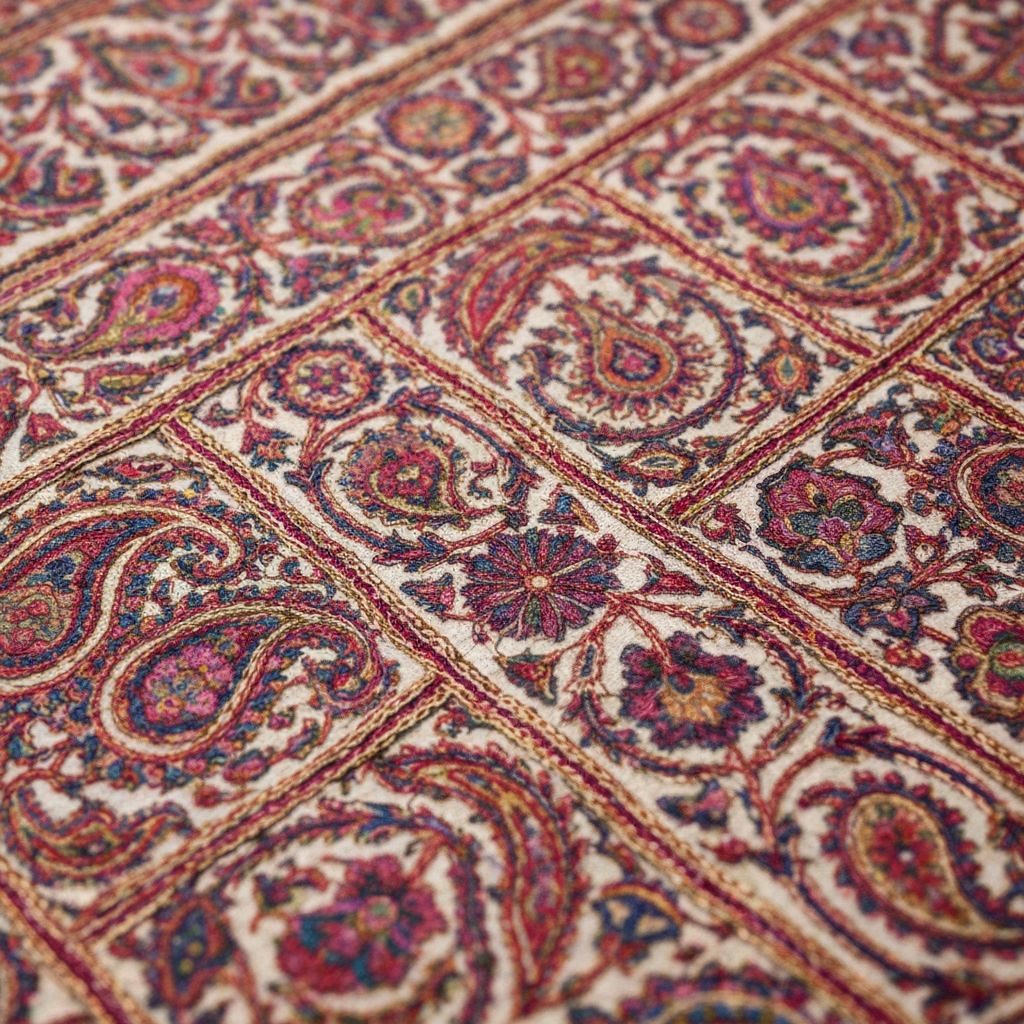
Kashmiri Embroidery
Chain stitches that cover fabric like snowflakes cover the valley — the exquisite needle art of Kashmir.
Origin
Srinagar, Kashmir
History
700+ Years
Technique
Aari & Sozni Stitch
Recognition
GI Tagged
In the mist-wrapped valleys of Kashmir, where Chinar trees blaze crimson in autumn and snow blankets the Himalayas, a needle art of extraordinary delicacy has flourished for over seven centuries. Kashmiri embroidery — whether the fine Sozni or the bold Aari — transforms plain pashmina into gardens of silk, where every petal and leaf is rendered in thousands of tiny stitches.
The tradition is said to have arrived with Sufi saint Mir Sayyid Ali Hamadani in the 14th century, who brought 700 Persian craftsmen to the valley. Under the patronage of Mughal emperors and later the Dogra rulers, Kashmiri shawls became symbols of aristocratic refinement across the world. Napoleon's Empress Joséphine reportedly owned over 400 Kashmiri shawls; Queen Victoria commissioned dozens.
A fully embroidered pashmina shawl — called a "jamawar" — can take two to three years to complete, with multiple artisans working on different sections. The finest Sozni shawls are reversible, with stitches so precise that both sides are equally beautiful. Such pieces are family heirlooms, passed down through generations.
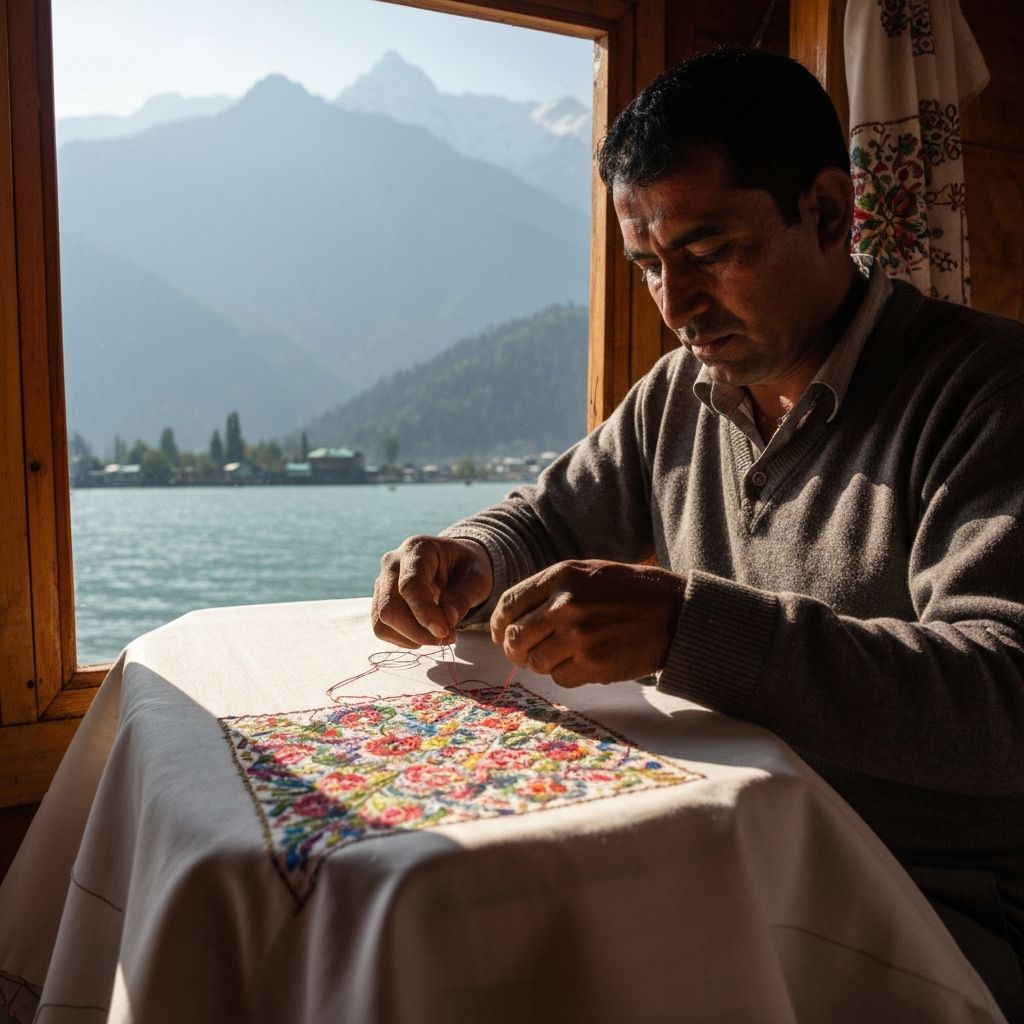
A Kashmiri artisan working Aari chain stitch embroidery on a pashmina shawl in Srinagar
Distinctive Features
Chain Stitch (Aari)
Interlocking loops created with a hooked needle called aari
Sozni Needlework
Fine satin stitch using a thin needle for detailed outlines
Full Coverage
Embroidery often covers the entire fabric surface
Vibrant Palette
Rich jewel tones — ruby, emerald, sapphire, and saffron
Pashmina Base
The finest work is done on pashmina and shahtoosh shawls
Reversible Patterns
Sozni work is equally beautiful on both sides
Varieties of Kashmiri Needlework
Sozni
Fine needle embroidery with tiny satin stitches, the most refined form
Aari
Chain stitch using a hooked needle, allows faster coverage of large areas
Papier-mâché Style
Bold, raised embroidery inspired by Kashmiri lacquerware
Tilla
Gold and silver thread work combined with silk embroidery
Crewel
Wool-on-cotton embroidery for curtains, upholstery, and rugs
Jalakdozi
Net-like openwork embroidery creating a lattice effect
Traditional Motifs
The Chinar Leaf
The most iconic motif in Kashmiri embroidery is the Chinar leaf — the maple-like tree that defines the Kashmir landscape. Centuries old Chinars line the avenues of Srinagar and the banks of Dal Lake, their five-lobed leaves turning brilliant gold and red in autumn. In embroidery, the Chinar is rendered in endless variations: stylized geometric, naturalistic, or interwoven with vines. It symbolizes longevity, resilience, and the eternal beauty of the valley.
Identifying Authentic Kashmiri Work
- Sozni embroidery is reversible — check both sides for equal quality
- Aari work has slightly raised chain stitches; machine embroidery lies flat
- Authentic pieces have slight irregularities; perfect uniformity suggests machine work
- Look for GI certification and craft council labels
- Buy from government emporiums (J&K Handicrafts) or certified cooperatives